
Table of Contents
Xeon E5‑2630 v4 is one of the entry‑level 10‑core processors for LGA2011‑3. It’s a cool‑running, energy‑efficient model with decent multi‑threaded performance, but low all‑core frequency under full load.
The processor is often found in prebuilt systems sold on AliExpress and other marketplaces. Let’s see what this model can do today and whether it’s worth buying for a dirt-cheap starter build.
Specifications
| Model | Xeon e5 2630 v4 |
|---|---|
| Socket | LGA2011-3 |
| Release Date | Q1 2016 |
| Architecture | Broadwell-EP, 14 nm |
| Cores / Threads | 10 / 20 |
| Memory support | DDR4-2133, 4-channel |
| Base Frequency | 2300 MHz |
| Max Turbo Frequency | 3100 MHz (1-2 Cores) 2900 MHz (3 Cores) 2900 MHz (4 Cores) 2700 MHz (5 Cores) 2600 MHz (6 Cores) 2500 MHz (7 Cores) 2400 MHz (8-10 Cores) |
| Extensions & Features | MMX instructions SSE / Streaming SIMD Extensions SSE2 / Streaming SIMD Extensions 2 SSE3 / Streaming SIMD Extensions 3 SSSE3 / Supplemental Streaming SIMD Extensions 3 SSE4 / SSE4.1 + SSE4.2 / Streaming SIMD Extensions 4 AES / Advanced Encryption Standard instructions AVX / Advanced Vector Extensions AVX2 / Advanced Vector Extensions 2.0 BMI / BMI1 + BMI2 / Bit Manipulation instructions F16C / 16-bit Floating-Point conversion instructions FMA3 / 3-operand Fused Multiply-Add instructions EM64T / Extended Memory 64 technology / Intel 64 HT / Hyper-Threading technology VT-x / Virtualization technology VT-d / Virtualization for directed I/O TBT 2.0 / Turbo Boost technology 2.0 TSX / Transactional Synchronization Extensions NX / XD / Execute disable bit ? TXT / Trusted Execution technology Enhanced Intel SpeedStep technology |
| L3 Cache | 25 Mb |
| PCIe Lanes | 40, Gen 3.0 |
| TDP | 85 W |
| Maximum operating temperature | 74°C |
| Multiplier | Locked |
| Integrated Graphics | None |
| CPUID | 0x406F1 |
| Approximate Price |
Main advantages of the model in 2026:
- Many cores, decent level of multi‑threaded performance
- Very low heat generation, no need for expensive coolers
- Very low power consumption; runs perfectly even on ultra-budget motherboards
- Very low price
Main disadvantages:
- Aging architecture with low IPC compared to modern CPUs
- Very low clock frequency
- Maximum memory frequency of only 2133 MHz (though it supports quad‑channel)
Overclocking Capability
The CPU has a locked multiplier, meaning traditional overclocking is completely off the table. Only some branded motherboards can slightly raise the base clock, increasing frequency by 2–3%, but a tiny bump like that won’t give you any real-world performance gains.

Performance and Tests
As expected, synthetics show a clear picture: while the E5‑2630 v4 delivers respectable multi‑threaded results, its single‑threaded performance leaves much to be desired.
CPU‑Z

Cinebench R15, R20, R23, 2024


PassMark

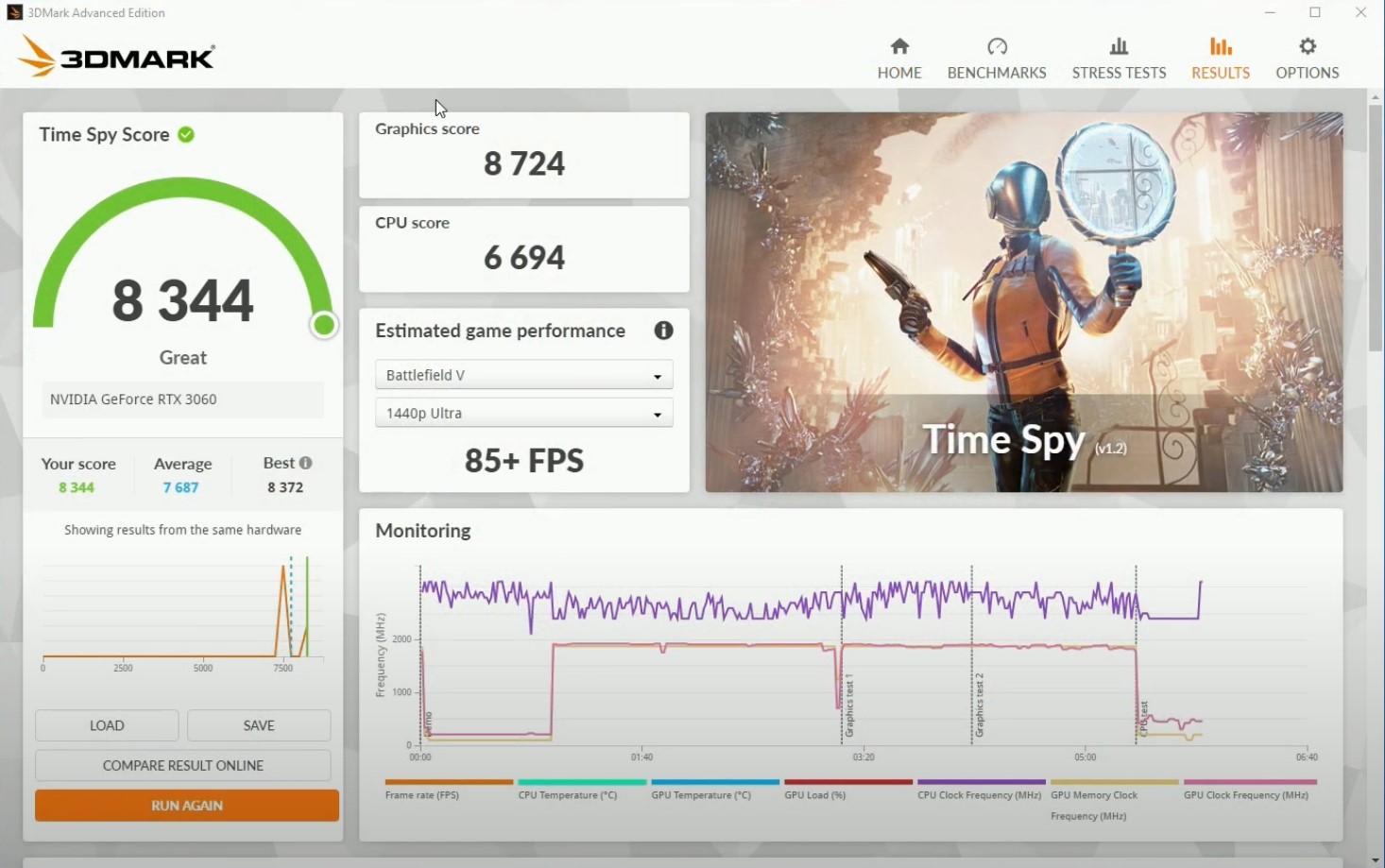
3DMark Time Spy
Summary
| Xeon E5 2640 v4 | |
|---|---|
| CPU-Z (single) | ~340 |
| CPU-Z (multi) | ~3700 |
| Cinebench R15 | ~1300 |
| Cinebench R20 | ~3000 |
| Cinebench R23 | ~7650 |
| Cinebench 2024 | ~460 |
| PassMark (Multithread) | ~11500 |
| 3DMark Time Spy (CPU) | ~6700 |
See more synthetic and gaming tests in the video:

Similar Models (multi‑threaded performance)
| Model | Cores / Threads | Cinebench R15 | Cinebench R20 | Cinebench R23 | CPU-Z Multi |
|---|---|---|---|---|---|
| Intel Xeon E5-2630 v4 | 10c / 20t | ~1300 | ~3000 | ~7650 | ~3700 |
| Intel Xeon E5-2650 v4 | 12c / 24t | ~1550 | ~3640 | ~9400 | ~4700 |
| Intel Core i7-8700K | 6c / 12t | ~1450 | ~3500 | ~9200 | ~4000 |
| AMD Ryzen 5 3600 | 6c / 12t | ~1550 | ~3600 | ~9200 | ~4200 |
As you can see, more modern CPUs need fewer cores to achieve similar multi‑threaded results, which shows just how weak the E5-2630 v4’s single-core performance is.
Gaming Performance
The Xeon E5-2630 v4 is clearly not a gaming CPU, so don’t expect it to deliver smooth performance across all modern titles. The low clock speed will cause noticeable frame drops in CPU‑intensive games. On the bright side, this CPU belongs to the LCC (Low Core Count) family, which typically provides slightly lower memory latency than higher‑core models.
That said, it easily handles well‑optimized multi‑threaded games and does fine in most esports titles.
- Games up to 2020: 75% run well (60+ FPS), 15% are playable (40–60 FPS), 10% are unplayable (low FPS, stutters, micro‑stutters).
- Games 2020–2026: 50% run well (60+ FPS), 30% are playable (40–60 FPS), 20% are unplayable (low FPS, stutters, micro‑stutters).
If you’re choosing a very budget gaming solution, our advice is to add just a little more and get a higher‑frequency CPU, for example the Xeon E5‑2680 v4.
Best GPU Pairings for Full HD and 1440p: Nvidia 1070 (Ti), 1660 (Ti/Super), 2060 (Super), 3060 (Ti); AMD RX 580, RX 5600 (XT), RX 5700 (XT), RX 6600 (XT).
Performance with RX 580 (2048SP 8 GB):

Performance with RX 6600:

Close Alternatives
- Xeon E5‑2643 v3 — features only 6 cores but offers a much higher clock speed
- Xeon E5‑2640 v4 — essentially the same as the E5‑2630 v4, but with a slightly higher clock
- Xeon E5‑2650 v4 — 2 more cores and +100 MHz all‑core; also not demanding about the motherboard
- Xeon E5‑2680 v4 — 14/28, higher frequency, more cache. A reasonable upper limit for budget boards.
See the complete list of processors for socket 2011‑3 here.
Revisions
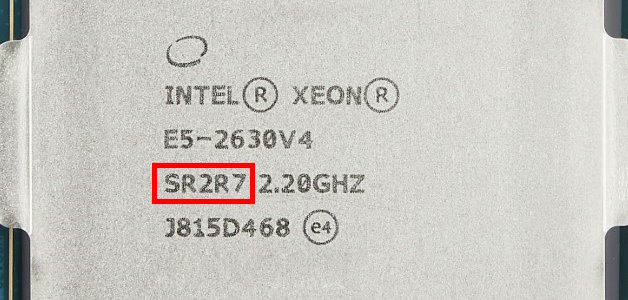
Besides the final version, there are also engineering versions of the E5‑2630 v4. They can be identified by the S‑spec code engraved on the heat spreader. The final version has code SR2R7. The stepping/revision can also be determined using the HWiNFO utility.
| S‑spec code | Stepping | Version |
|---|---|---|
| SR2R7 | R0 | Final |
| QKET | R0 | QS/ES |
| QKRH | R0 | QS/ES |
| QHVK | L0 | QS/ES |
Frequently Asked Questions
Is TBU (Turbo Boost Unlock) possible?
No, TBU is only possible on Haswell (v3) processors.
Is undervolting possible?
Only for QS models; in final versions the ability to undervolt is locked.
Is there solder or thermal paste under the IHS?
There’s solder under the heat spreader, just like the rest of the Xeon E5 v3/v4 lineup.
Is the processor compatible with Windows 11?
No, the Xeon E5‑2630 v4 is not officially supported by Windows 11, but it works fine if you bypass the CPU requirements.

Written by
Senior Hardware Specialist proving you don't need top-tier gear to game. Expert in smart upgrades and budget-friendly PC restoration.