Table of Contents
Introduced in 2011, the LGA2011 platform marked the start of Intel’s modern high‑end desktop (HEDT) era. Based on Sandy Bridge‑E (and later Ivy Bridge‑E), it replaced the aging LGA1366 socket and brought quad‑channel DDR3, up to 40 PCIe 3.0 lanes, and support for multi‑GPU and high‑bandwidth storage.
Like its successor (LGA2011‑3), the platform served two primary markets:
- The HEDT segment, with Core i7 processors such as the 3930K and 4960X targeting enthusiasts and overclockers;
- The workstation and server sector, featuring Xeon E5‑1600 and E5‑2600/E5-4600 (v1/v2) designed for reliability and scalability.
Despite its age, it still appeals to hobbyists and budget builders thanks to solid performance, overclocking flexibility, and the wide availability of inexpensive Xeon CPUs on the used market.
Below, we cover the socket’s architectures and notable processors, then assess its relevance in 2026.
LGA2011 Processor Architectures and Features
Sandy Bridge‑E / Sandy Bridge‑EP
In late 2011, Intel launched Sandy Bridge‑E for high‑end desktops (X79) and Sandy Bridge‑EP for servers (Xeon E5‑2600\4600 v1). They shared the socket and the Patsburg chipset family (X79/C60x), bringing quad‑channel DDR3 and a large slice of on‑die PCIe to the platform.
Key architectural features:
- Process node: 32 nm
- Sandy Bridge core with ring bus and large shared L3 (up to 20 MB on top SKUs)
- Quad‑channel DDR3 controller, officially up to DDR3‑1600; ECC on Xeon
- 40 PCIe lanes from the CPU; Gen 3 capable (early X79 validation varied by board/BIOS and GPU)
- Instruction set: AVX (256‑bit), SSE4.2, AES‑NI, VT‑x/VT‑d; no FMA, no TSX
- No integrated GPU
- Desktop: up to 6 cores. Server: up to 8 cores
- Platform: X79 (consumer) and C600‑series (server) PCH via DMI 2.0; extra SAS/SATA via RSTe on C60x
- Overclocking: unlocked SKUs plus BCLK “strap” ratios (typically 100/125/166 MHz)
Sandy Bridge‑E/EP became a favorite for early HEDT builds and later budget workstations, thanks to plentiful PCIe lanes and strong multi‑threaded performance for its time.
Ivy Bridge‑E / Ivy Bridge‑EP
In 2013, Intel refreshed the platform with Ivy Bridge‑E for HEDT and Ivy Bridge‑EP for servers (Xeon E5‑2600\4600 v2), keeping the same socket and X79/C60x chipsets via BIOS updates. The 22 nm shrink improved efficiency and enabled higher core counts on Xeon.
Key architectural features:
- Process node: 22 nm Tri‑Gate
- Modest IPC uplift and lower power vs. Sandy Bridge‑E (roughly 3–6% per clock in many workloads)
- Quad‑channel DDR3, now officially up to DDR3‑1866; ECC on Xeon
- Fully validated PCIe 3.0 with 40 lanes from the CPU
- Instruction set: AVX (not AVX2), AES‑NI, SSE4.2, F16C, RDRAND; no TSX
- Security/virtualization refinements (e.g., SMEP), VT‑x/VT‑d retained
- No integrated GPU
- Desktop: up to 6 cores. Server: up to 12 cores and 30 MB L3
- Better Turbo/power gating and thermals; continued support for BCLK strap OC on unlocked parts
Ivy Bridge‑E/EP extended the life of the ecosystem, delivering cooler, quieter systems with more threads on Xeon while preserving the platform’s hallmarks: high memory bandwidth and ample PCIe connectivity.
All Socket 2011 Processors and Their Specifications
Core i7 3000 Series
| Model | Cores / Threads | Base Frequency | Max Turbo Frequency | L3 Cache | Multiplier | Memory support | TDP |
|---|---|---|---|---|---|---|---|
| Core i7-3820 | 4 / 8 | 3.6 GHz | 3.8 GHz | 10 MB | Locked | DDR3-1600 | 130 W |
| Core i7-3930K | 6 / 12 | 3.2 GHz | 3.8 GHz | 12 MB | Unlocked | DDR3-1600 | 130 W |
| Core i7-3960K | 6 / 12 | 3.3 GHz | 3.9 GHz | 15 MB | Unlocked | DDR3-1600 | 130 W |
| Core i7-3970K | 6 / 12 | 3.5 GHz | 4.0 GHz | 15 MB | Unlocked | DDR3-1600 | 150 W |
Core i7 4000 Series
| Model | Cores / Threads | Base Frequency | Max Turbo Frequency | L3 Cache | Multiplier | Memory support | TDP |
|---|---|---|---|---|---|---|---|
| Core i7-4820K | 4 / 8 | 3.7 GHz | 3.9 GHz | 10 MB | Unlocked | DDR3-1866 | 130 W |
| Core i7-4930K | 6 / 12 | 3.4 GHz | 3.9 GHz | 12 MB | Unlocked | DDR3-1866 | 130 W |
| Core i7-4960X | 6 / 12 | 3.6 GHz | 4.0 GHz | 15 MB | Unlocked | DDR3-1866 | 130 W |
Xeon E5 1600
| Model | Cores / Threads | Base Frequency | Max Turbo Frequency | L3 Cache | Multiplier | Memory support | TDP |
|---|---|---|---|---|---|---|---|
| Xeon E5 1603 | 4 / 4 | 2.8 GHz | - | 10 MB | Locked | DDR3-1066 | 130W |
| Xeon E5 1607 | 4 / 4 | 3.0 GHz | - | 10 MB | Locked | DDR3-1066 | 130W |
| Xeon E5 1620 | 4 / 8 | 3.6 GHz | 3.8 GHz | 10 MB | Unlocked | DDR3-1600 | 130W |
| Xeon E5 1650 | 6 / 12 | 3.2 GHz | 3.8 GHz | 12 MB | Unlocked | DDR3-1600 | 130W |
| Xeon E5 1660 | 6 / 12 | 3.3 GHz | 3.9 GHz | 15 MB | Unlocked | DDR3-1600 | 130W |
Xeon E5 1600 v2
| Model | Cores / Threads | Base Frequency | Max Turbo Frequency | L3 Cache | Multiplier | Memory support | TDP |
|---|---|---|---|---|---|---|---|
| Xeon E5 1607 v2 | 4 / 4 | 3.0 GHz | - | 10 MB | Locked | DDR3-1600 | 130W |
| Xeon E5 1620 v2 | 4 / 8 | 3.7 GHz | 3.9 GHz | 10 MB | Locked | DDR3-1866 | 130W |
| Xeon E5 1650 v2 | 6 / 12 | 3.5 GHz | 3.9 GHz | 12 MB | Unlocked | DDR3-1866 | 130W |
| Xeon E5 1660 v2 | 6 / 12 | 3.7 GHz | 4.0 GHz | 15 MB | Unlocked | DDR3-1866 | 130W |
| Xeon E5 1680 v2 | 8 / 16 | 3.0 GHz | 3.9 GHz | 25 MB | Unlocked | DDR3-1866 | 130W |
Xeon E5 2600
| Model | Cores / Threads | Base Frequency | Max Turbo Frequency | L3 Cache | Memory support | TDP |
|---|---|---|---|---|---|---|
| Xeon E5 2603 | 4 / 4 | 1.8 GHz | - | 10 MB | DDR3-1066 | 80W |
| Xeon E5 2609 | 4 / 4 | 2.4 GHz | - | 10 MB | DDR3-1066 | 80W |
| Xeon E5 2620 | 6 / 12 | 2 GHz | 2.5 GHz | 15 MB | DDR3-1333 | 95W |
| Xeon E5 2630 | 6 / 12 | 2.3 GHz | 2.8 GHz | 15 MB | DDR3-1333 | 95W |
| Xeon E5 2630L | 6 / 12 | 2 GHz | 2.5 GHz | 15 MB | DDR3-1333 | 60W |
| Xeon E5 2637 | 2 / 4 | 3 GHz | 3.5 GHz | 5 MB | DDR3-1600 | 80W |
| Xeon E5 2640 | 6 / 12 | 2.5 GHz | 3 GHz | 15 MB | DDR3-1333 | 95W |
| Xeon E5 2643 | 4 / 8 | 3.3 GHz | 3.5 GHz | 10 MB | DDR3-1600 | 130W |
| Xeon E5 2650 | 8 / 16 | 2 GHz | 2.8 GHz | 20 MB | DDR3-1600 | 95W |
| Xeon E5 2650L | 8 / 16 | 1.8 GHz | 2.3 GHz | 20 MB | DDR3-1600 | 70W |
| Xeon E5 2660 | 8 / 16 | 2.2 GHz | 3 GHz | 20 MB | DDR3-1600 | 95W |
| Xeon E5 2665 | 8 / 16 | 2.4 GHz | 3.1 GHz | 20 MB | DDR3-1600 | 115W |
| Xeon E5 2667 | 6 / 12 | 2.9 GHz | 3.5 GHz | 15 MB | DDR3-1600 | 130W |
| Xeon E5 2670 | 8 / 16 | 2.6 GHz | 3.3 GHz | 20 MB | DDR3-1600 | 115W |
| Xeon E5 2680 | 8 / 16 | 2.7 GHz | 3.5 GHz | 20 MB | DDR3-1600 | 130W |
| Xeon E5 2687W | 8 / 16 | 3.1 GHz | 3.8 GHz | 20 MB | DDR3-1600 | 150W |
| Xeon E5 2689 | 8 / 16 | 2.6 GHz | 3.6 GHz | 20 MB | DDR3-1600 | 115W |
| Xeon E5 2690 | 8 / 16 | 2.9 GHz | 3.8 GHz | 20 MB | DDR3-1600 | 135W |
Xeon E5 2600 v2
| Model | Cores / Threads | Base Frequency | Max Turbo Frequency | L3 Cache | Memory support | TDP |
|---|---|---|---|---|---|---|
| Xeon E5 2620 v2 | 6 / 12 | 2.1 GHz | 2.6 GHz | 15 MB | DDR3-1600 | 80W |
| Xeon E5 2630 v2 | 6 / 12 | 2.6 GHz | 3.1 GHz | 15 MB | DDR3-1600 | 80W |
| Xeon E5 2640 v2 | 8 / 16 | 2 GHz | 2.5 GHz | 20 MB | DDR3-1600 | 95W |
| Xeon E5 2643 v2 | 6 / 12 | 3.5 GHz | 3.8 GHz | 25 MB | DDR3-1866 | 130W |
| Xeon E5 2650 v2 | 8 / 16 | 2.6 GHz | 3.4 GHz | 20 MB | DDR3-1866 | 95W |
| Xeon E5 2650L v2 | 10 / 20 | 1.7 GHz | 2.1 GHz | 25 MB | DDR3-1600 | 70W |
| Xeon E5 2651 v2 | 12 / 24 | 1.8 GHz | - | 30 MB | DDR3-1866 | |
| Xeon E5 2660 v2 | 10 / 20 | 2.2 GHz | 3 GHz | 25 MB | DDR3-1866 | 95W |
| Xeon E5 2667 v2 | 8 / 16 | 3.3 GHz | 4 GHz | 25 MB | DDR3-1866 | 130W |
| Xeon E5 2670 v2 | 10 / 20 | 2.5 GHz | 3.3 GHz | 25 MB | DDR3-1866 | 115W |
| Xeon E5 2673 v2 | 8 / 16 | 3.3 GHz | 4 GHz | 25 MB | DDR3-1866 | 110W |
| Xeon E5 2680 v2 | 10 / 20 | 2.8 GHz | 3.6 GHz | 25 MB | DDR3-1866 | 115W |
| Xeon E5 2687W v2 | 8 / 16 | 3.4 GHz | 4 GHz | 25 MB | DDR3-1866 | 150W |
| Xeon E5 2690 v2 | 10 / 20 | 3 GHz | 3.6 GHz | 25 MB | DDR3-1866 | 130W |
| Xeon E5 2695 v2 | 12 / 24 | 2.4 GHz | 3.2 GHz | 30 MB | DDR3-1866 | 115W |
| Xeon E5 2696 v2 | 12 / 24 | 2.5 GHz | 3.3 GHz | 30 MB | DDR3-1866 | |
| Xeon E5 2697 v2 | 12 / 24 | 2.7 GHz | 3.5 GHz | 30 MB | DDR3-1866 | 130W |
Xeon E5 4600
| Model | Cores / Threads | Base Frequency | Max Turbo Frequency | L3 Cache | Memory support | TDP |
|---|---|---|---|---|---|---|
| Xeon E5 4603 | 4 /8 | 2 GHz | - | 10 MB | DDR3-1066 | 95W |
| Xeon E5 4607 | 6 / 12 | 2.2 GHz | - | 12 MB | DDR3-1066 | 95W |
| Xeon E5 4610 | 6 / 12 | 2.4 GHz | 2.9 GHz | 15 MB | DDR3-1333 | 95W |
| Xeon E5 4617 | 6 / 6 | 2.9 GHz | 3.4 GHz | 15 MB | DDR3-1600 | 130W |
| Xeon E5 4620 | 8 / 16 | 2.2 GHz | 2.6 GHz | 16 MB | DDR3-1333 | 95W |
| Xeon E5 4640 | 8 / 16 | 2.4 GHz | 2.8 GHz | 20 MB | DDR3-1600 | 95W |
| Xeon E5 4650 | 8 / 16 | 2.7 GHz | 3.3 GHz | 20 MB | DDR3-1600 | 130W |
| Xeon E5 4650L | 8 / 16 | 2.6 GHz | 3.1 GHz | 20 MB | DDR3-1600 | 115W |
Xeon E5 4600 v2
| Model | Cores / Threads | Base Frequency | Max Turbo Frequency | L3 Cache | Memory support | TDP |
|---|---|---|---|---|---|---|
| Xeon E5 4603 v2 | 4 / 8 | 2.2 GHz | - | 10 MB | DDR3-1333 | 95W |
| Xeon E5 4607 v2 | 6 / 12 | 2.6 GHz | - | 15 MB | DDR3-1333 | 95W |
| Xeon E5 4610 v2 | 8 / 16 | 2.3 GHz | 2.7 GHz | 16 MB | DDR3-1600 | 95W |
| Xeon E5 4620 v2 | 8 / 16 | 2.6 GHz | 3 GHz | 20 MB | DDR3-1600 | 95W |
| Xeon E5 4627 v2 | 8 / 8 | 3.3 GHz | 3.6 GHz | 16 MB | DDR3-1866 | 130W |
| Xeon E5 4640 v2 | 10 / 20 | 2.2 GHz | 2.7 GHz | 20 MB | DDR3-1866 | 95W |
| Xeon E5 4650 v2 | 10 / 20 | 2.4 GHz | 2.9 GHz | 25 MB | DDR3-1866 | 95W |
| Xeon E5 4657L v2 | 12 / 24 | 2.4 GHz | 2.9 GHz | 30 MB | DDR3-1866 | 115W |
Processor Recommendations by Use Case
Best processors for overclocking:
- Xeon E5‑1680 v2 (Ivy Bridge, 8/16, 25 MB L3) — reaches 4.5–4.8 GHz on quality boards; near‑maximum performance for the socket.
- Core i7‑4960X / Xeon E5‑1660 v2 (Ivy Bridge, 6/12, 15 MB L3) — 4.6–5.0 GHz on branded/retail boards; noticeably cheaper than the E5‑1680 v2.
- Core i7‑3970X / Xeon E5‑1660 (Sandy Bridge, 6/12, 15 MB L3) — capable of 4.7–5.2 GHz but runs significantly hotter and draws more power.
Some low‑cost Chinese boards can overclock, but most top out around 4.0–4.3 GHz. For higher targets, you’ll need high‑end motherboards from the platform’s heyday.
Best locked processors for gaming:
- Xeon E5‑2687W v2 (Ivy Bridge, 8C/16T, 3.4 GHz base / 4.0 GHz turbo, 25 MB L3, 150 W TDP) — top‑end 8‑core with turbo up to 4.0 GHz. High TDP; demanding on VRM.
- Xeon E5‑2667 v2 (Ivy Bridge, 8C/16T, 3.3 GHz base / 4.0 GHz turbo, 25 MB L3, 130 W TDP) — similar to the 2687W v2 with a lower TDP limit.
Best locked processors for workstation tasks:
- Xeon E5‑2697 v2 (Ivy Bridge, 12C/24T, 2.7 / 3.5 GHz, 30 MB L3, 130 W) — maximum core count, decent clocks, plenty of cache.
- Xeon E5‑2690 v2 (Ivy Bridge, 10C/20T, 3.0 / 3.6 GHz, 25 MB L3, 130 W) — strong mid‑range choice with a good cores/clock balance.
- Xeon E5‑2687W v2 (Ivy Bridge, 8C/16T, 3.4 / 4.0 GHz, 25 MB L3, 150 W) — workstation‑focused model with the highest clocks for frequency‑sensitive workloads.
Compatibility
The platform originally used two chipset families — X79 and C600‑series (C602/C604/C606/C608) — all based on the Patsburg PCH. X79 targeted enthusiasts with Core i7, while C60x served servers and workstations with Xeon E5‑1600/2600/4600 (v1/v2). Despite the marketing split, the chipsets are broadly cross‑compatible: desktop CPUs run on many server boards, and Xeon E5 v1/v2 work on X79.
Key nuances and limitations:
- BIOS/microcode: Ivy Bridge‑E/EP (v2) support often requires a BIOS update; some older boards ship Sandy‑only.
- Memory: X79 retail boards typically support non‑ECC UDIMM; server C60x boards support ECC UDIMM/RDIMM (often LRDIMM). Many Chinese “X79” boards built on C602 also accept ECC RDIMM.
- PCIe: Up to 40 lanes come directly from the CPU. PCIe 3.0 support depends on BIOS and GPU; early X79 revisions had Gen3 quirks later addressed by firmware/drivers.
- Storage/I/O: Patsburg variants differ in SATA/SAS. SAS ports appear only on C606/C608 and require Intel RSTe; typical X79 boards expose fewer SATA 6 Gb/s ports. Native M.2/NVMe is rare on originals but common on Chinese boards.
- Overclocking: Only unlocked Core i7 “K/Extreme” and some E5‑1600 v1/v2 support multiplier OC. BCLK strap OC (100/125/166 MHz) exists but is uncommon on server boards; most Chinese boards lack straps.
- Socket topology: X79 and single‑socket C60x boards are 1P designs. Xeon E5‑2600 v1/v2 supports single‑ and dual‑socket; E5‑4600 v1/v2 adds quad‑socket.
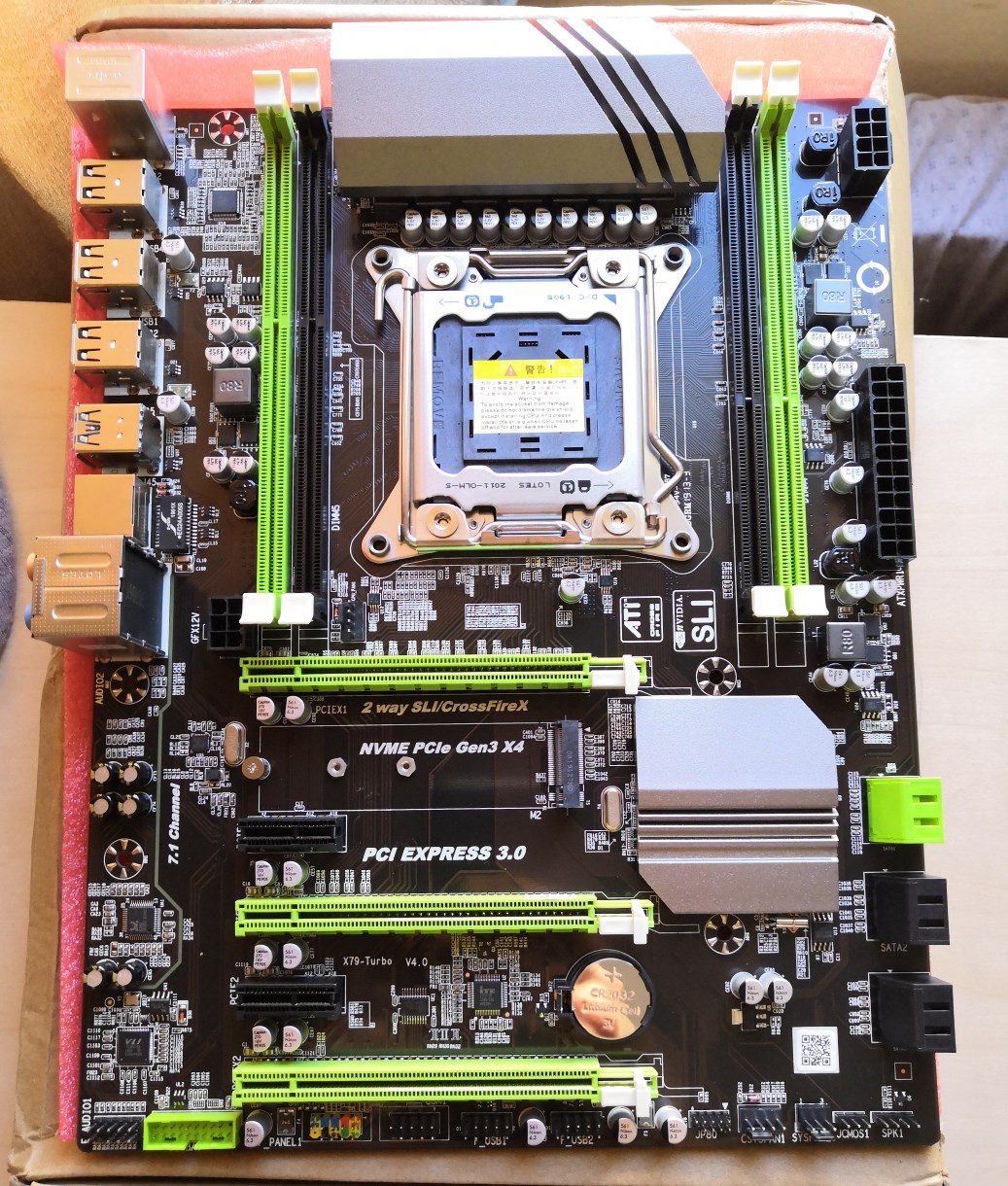
Later, Chinese manufacturers paired these CPUs with older desktop chipsets (e.g., Q67/H67/B75) using custom BIOS. The resulting budget “X79” boards usually work with Xeon E5 v1/v2 but come with trade‑offs: trimmed I/O (fewer SATA/USB, no SAS/RSTe), mixed ECC/RDIMM support, fewer BIOS options (power management, bifurcation, OC), and occasionally unstable sleep states. Even so, they enabled very low‑cost builds with cheap Xeons and ECC memory.
How the LGA2011 Platform Holds Up in 2026
There’s still plenty of capability here: higher‑end locked CPUs and overclocked unlocked models can deliver respectable FPS in many modern games. Quad‑channel DDR3 reaches roughly 50 GB/s of bandwidth, which is strong for its age.
The main drawback is the lack of newer instruction sets such as AVX2. They’re often required in professional software (x265/HandBrake, some render engines, compressors, emulators) and in games. As a result, the platform isn’t fully universal: expect lower performance or, at times, incompatibility. Otherwise, it remains fine for web, office work, and a large share of titles.
Even without overclocking, the Xeon E5-1650 v2 can deliver decent FPS:

Synthetic and gaming tests of the Xeon E5-2667 v2:

Even more tests of the Xeon E5-2667 v2:

Building from scratch rarely makes sense in 2026. While AliExpress and similar sites let you assemble a capable PC for little money, LGA2011‑3 (with AVX2) is usually the better budget target. Also factor in legacy I/O and higher power draw. However, if you already own a solid motherboard or a decent CPU with memory, adding the missing pieces can yield a surprisingly capable system for very little.

Written by
Senior Hardware Specialist proving you don't need top-tier gear to game. Expert in smart upgrades and budget-friendly PC restoration.
My E5-2667 v2 was really good, but it’s hard to manage without AVX2 nowadays. I switched to LGA2011-3 and went with the E5-2690 v4. Feeling comfortable with this setup and RTX 3060Ti.
Comback in 2026, My Xeon 1680v2 have to enough power to operate my PC in gaming and daily workbench with 2k 165hz monitor. It magical when boost eight core @ 4.5Ghz just using air cooling tower.