
Table of Contents
Xeon E5-2670 v3 is a 12-core Haswell-EP CPU that is inexpensive and easy to find, often coming from pre-built systems. Out of the box, its specs look modest, but with Turbo Boost Unlock (TBU) it delivers solid multi-threaded performance.
Specifications
| Model | Xeon e5 2670 v3 |
|---|---|
| Socket | LGA2011-3 |
| Release Date | Q3 2014 |
| Architecture | Haswell-EP, 22 nm |
| Cores / Threads | 12 / 24 |
| Memory support | DDR4-2133, 4-channel |
| Base Frequency | 2300 MHz |
| Max Turbo Frequency | 3100 MHz (1-2 Cores) 2900 MHz (3 Cores) 2800 MHz (4 Cores) 2700 MHz (5 Cores) 2600 MHz (6-12 Cores) |
| Extensions & Features | MMX instructions SSE / Streaming SIMD Extensions SSE2 / Streaming SIMD Extensions 2 SSE3 / Streaming SIMD Extensions 3 SSSE3 / Supplemental Streaming SIMD Extensions 3 SSE4 / SSE4.1 + SSE4.2 / Streaming SIMD Extensions 4 AES / Advanced Encryption Standard instructions AVX / Advanced Vector Extensions AVX2 / Advanced Vector Extensions 2.0 BMI / BMI1 + BMI2 / Bit Manipulation instructions F16C / 16-bit Floating-Point conversion instructions FMA3 / 3-operand Fused Multiply-Add instructions EM64T / Extended Memory 64 technology / Intel 64 HT / Hyper-Threading technology VT-x / Virtualization technology VT-d / Virtualization for directed I/O TBT 2.0 / Turbo Boost technology 2.0 NX / XD / Execute disable bit ? TXT / Trusted Execution technology Enhanced Intel SpeedStep technology |
| L3 Cache | 30 Mb |
| PCIe Lanes | 40, Gen 3.0 |
| TDP | 120 W |
| Maximum operating temperature | 84.5°C |
| Multiplier | Locked |
| Integrated Graphics | None |
| CPUID | 0x306F2 |
| Approximate Price |
- 12 cores and good multi-threaded performance
- Moderate heat output; works with affordable 2–3 heat pipe coolers
- Reasonable power draw; compatible with budget X99 boards
- Low price
Main disadvantages:
- Aging architecture; lower IPC compared to modern CPUs
- Modest clocks even with TBU
- DDR4-2133 limit (quad channel helps with bandwidth)
Overclocking Capability
Turbo Boost Unlock
Turbo Boost Unlock on Xeon E5 v3 forces the CPU to hold its maximum single‑core turbo ratio across all cores. It leverages an unintended Haswell-EP behavior—a bug, not a planned Intel feature, which can be applied through various methods, such as BIOS modification via S3TurboTool, and typically yields 10–30% gains in multi‑threaded workloads, depending on SKU and cooling. Expect higher sustained power and thermals; use strong cooling and ensure that the motherboard’s power subsystem can handle the increased load.
Nowadays, applying the Turbo Boost unlock is practically a must; without it, Haswell processors would no longer be sufficient for many modern tasks, including gaming.
Base Clock (BCLK) Overclocking
Only some branded boards released during the heyday of LGA2011-3 are capable of slightly raising BCLK, increasing frequency by 3-5%, but such overclocking won’t make a meaningful difference. Can be applied either separately or together with TBU.

Performance and Tests
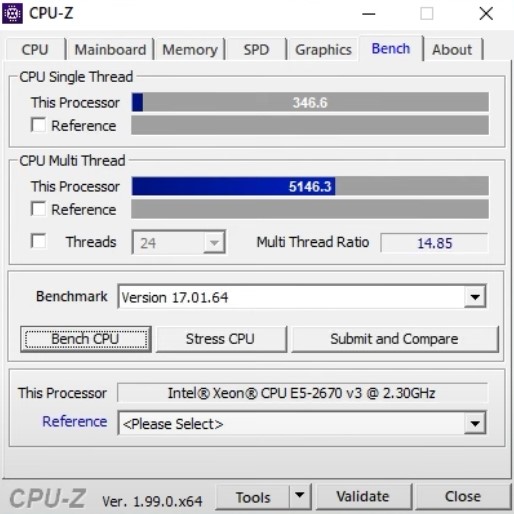
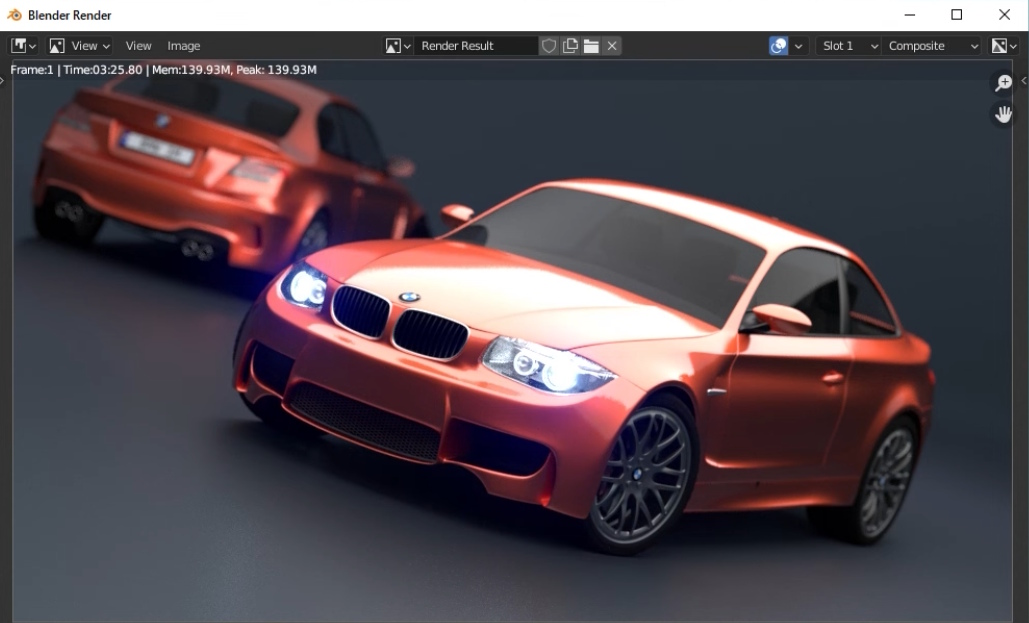
All tests below are with turbo boost unlock applied. Virtually all benchmarks show a decent level of multi-threaded performance, but weak single-core performance.
CPU-Z
Cinebench R15, R20, R23


CPU Mark

Blender (BMW)
AIDA64 CPU Queen

Corona Benchmark 1.3

Summary
| Xeon E5 2670 v3 (TBU) | |
|---|---|
| CPU-Z (single) | ~350 |
| CPU-Z (multi) | ~5150 |
| Cinebench R15 | ~1800 |
| Cinebench R20 | ~4000 |
| Cinebench R23 | ~10300 |
| CPU Mark | ~7800 |
| Blender (BMW) | ~03:25 |
| AIDA64 CPU Queen | ~89000 |
| Corona 1.3 | ~01:55 |
Similar models in terms of multi-threaded performance level:
| Model | Cores / Threads | Cinebench R15 | Cinebench R20 | Cinebench R23 | CPU-Z Multi |
|---|---|---|---|---|---|
| Xeon E5-2670 v3 | 12c / 24t | ~1800 | ~4020 | ~10300 | ~5150 |
| Xeon E5-2678 v3 | 12c / 24t | ~1900 | ~4200 | ~10800 | ~5300 |
| Xeon E5-2680 v4 | 14c / 28t | ~2100 | ~4700 | ~12200 | ~6400 |
| Ryzen 5 3600 | 6c / 12t | ~1600 | ~3700 | ~9900 | ~4800 |
| Ryzen 7 2700 | 8c / 16t | ~1500 | ~3400 | ~9500 | ~4400 |
| Core i7-9700 | 8c / 8t | ~1700 | ~3800 | ~9600 | ~4700 |
Gaming Performance
With turbo unlock enabled, gaming performance becomes quite respectable.
Xeon E5 2670 v3 is capable of delivering comfortable fps in many games, but modern titles heavily push the CPU to its limits, especially given its weaker single-core performance.
- Games up to 2020: 90% run well (60+ FPS), 10% are playable (40-60 FPS)
- Games 2020–2026: 70% run well (60+ FPS), 20% are playable (40-60 FPS), 10% are unplayable (low FPS, stutters, micro-freezes).
Best GPU Pairings for FullHD and 1440p: NVIDIA 1070 (Ti), 1660 (Super/Ti), 1080 (Ti), 2060 (Super), 3060 (Ti); AMD RX 580, RX 5600 XT, RX 5700 XT, RX 6600 (XT/6650 XT), RX 6700 XT, RX 7600 (XT).
Performance with RTX 3070Ti:

Close Alternatives
- Xeon E5 2678 v3\2680 v3 – offer slightly higher clock speeds at roughly the same price. The E5 2678 v3 is unique as it supports both DDR4 and DDR3 memory.
- Xeon E5 2697 v3 – top-tier 14-core processor. Noticeably more powerful, but runs hotter and is more demanding on motherboard VRM.
- Xeon E5 2680 v4 – 14-core on newer architecture. Good choice for budget boards.
See the complete list of processors for socket 2011-3 here.
Revisions
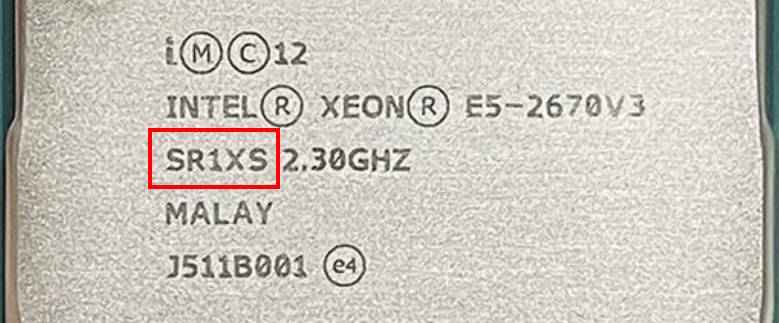
Besides the final version, there are also engineering versions of the E5 2670 v3. They can be distinguished by the s-spec code, which is engraved on the processor’s IHS. The final version has the code SR1XS. The revision can also be determined by the HWiNFO utility.
| S-spec Code | Stepping | Version |
|---|---|---|
| QFS0 | M0 | QS/ES |
| QGP2 | M1 | QS/ES |
| SR1XS | M1 | Final |
Frequently Asked Questions
Is undervolting possible?
Yes, voltage control is possible on v3 processors. Some ES models may be exceptions.
Is there solder or thermal paste under the IHS?
There’s solder under the IHS, as with the entire Xeon E5 v3\v4 lineup.
Is the processor compatible with Win11?
No, the Xeon E5-2670 v3 is not officially supported by Windows 11, but it works fine if you bypass the CPU and TPM checks during installation.

Written by
Senior Hardware Specialist proving you don't need top-tier gear to game. Expert in smart upgrades and budget-friendly PC restoration.