Table of Contents
LGA1356 (also known as Socket B2) debuted in early 2012, almost simultaneously with the flagship LGA2011 platform. Conceived as a more affordable and energy‑efficient alternative for mid‑range single‑ and dual‑processor servers and workstations, this socket became the successor to the legendary LGA1366 in its niche. Throughout its existence, the platform spanned two generations of architectures: Sandy Bridge‑EN and Ivy Bridge‑EN.
The main idea behind LGA1356 was a compromise between price and capabilities: unlike the “senior” LGA2011, it used a triple‑channel memory controller and a reduced number of PCIe lanes. This allowed manufacturers to create more compact and cheaper motherboards while still supporting powerful multi‑core Xeon E5‑2400‑series processors.
In this article, we’ll take a detailed look at the technical features of LGA1356 and the architectural nuances of the supported processors. We’ve also compiled the most comprehensive list we could of all existing chips for this socket.
LGA1356 Processor Architectures and Features
Sandy Bridge‑EN
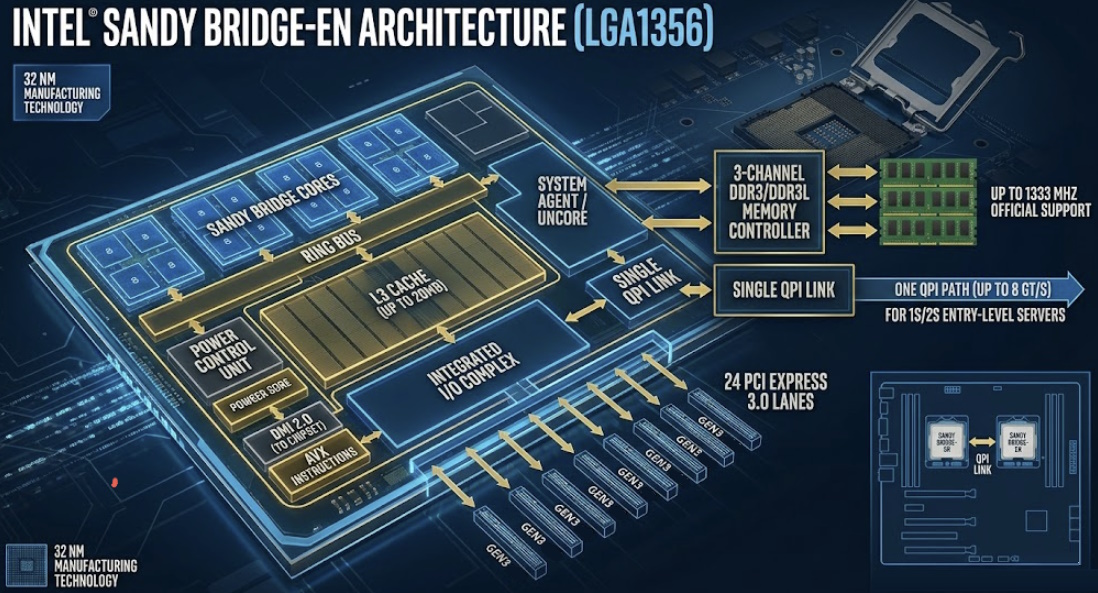
In early 2012, Intel introduced the Sandy Bridge‑EN (Entry) architecture, designed for entry‑level servers and workstations. In practice, it was a simplified version of the “senior” Sandy Bridge‑EP (LGA2011), intended to replace the LGA1366 platform in scenarios where maximum memory bandwidth and a large number of PCIe lanes were not required.
Key architectural features:
- Process technology: 32 nm.
- Memory controller: triple‑channel DDR3/DDR3L (up to 1333 MHz). This is the main difference from LGA2011, which used a quad‑channel controller.
- PCI Express lanes: 24 PCIe 3.0 lanes — fewer than the 40 lanes on LGA2011, but still significantly more than the 16 lanes available on consumer processors at the time.
- QPI bus: Sandy Bridge‑EN processors use a single QPI link (up to 8.0 GT/s), which limits the platform to dual‑socket configurations at most.
- Core count: up to 8 physical cores and 16 threads, with up to 20 MB of L3 cache in top‑tier SKUs.
- Instructions: AVX for heavy compute workloads, AES‑NI for fast encryption, and virtualization technologies (VT‑x/VT‑d), ensuring full compatibility with most software of that era.
Compared to “classic” LGA2011, LGA1356 was created as a platform that was cheaper to manufacture. By reducing the pin count (from 2011 to 1356) and simplifying the memory subsystem, manufacturers could produce boards with simpler PCB routing. In terms of raw per‑core performance, Sandy Bridge‑EN is identical to Sandy Bridge‑EP; however, it falls behind in workloads that are highly sensitive to memory bandwidth.
Ivy Bridge‑EN
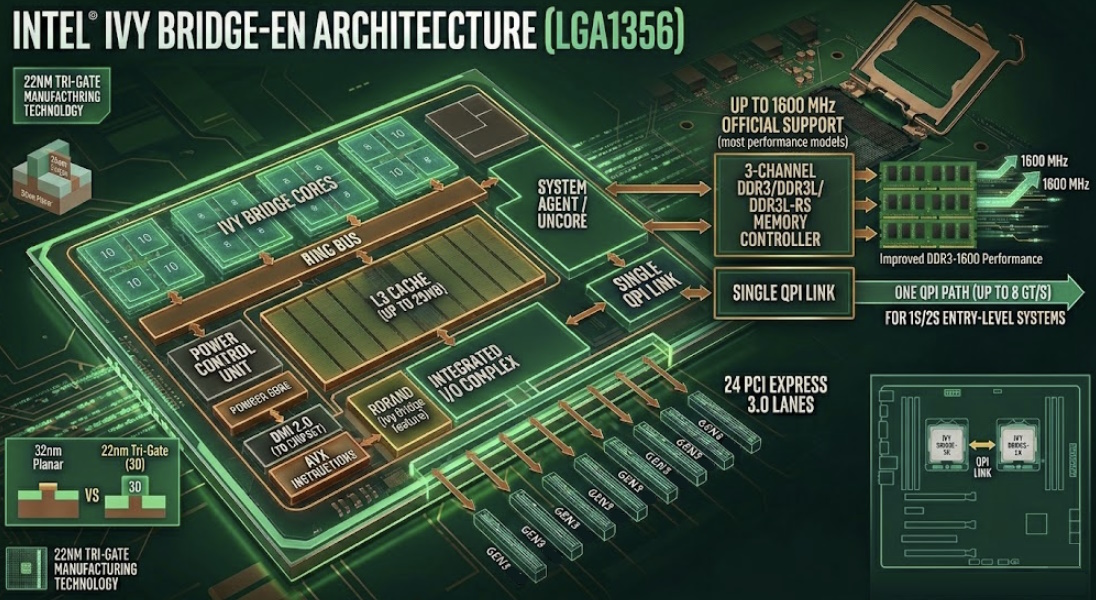
In early 2013, Intel refreshed the LGA1356 lineup with the Ivy Bridge‑EN architecture. This was a classic “tick” step in Intel’s strategy: moving the successful Sandy Bridge design to a newer, more advanced process node with small, targeted improvements.
Key architectural features:
- Process technology: 22 nm using 3D Tri‑Gate transistors, which significantly reduced power consumption and heat output compared to the first‑generation 32 nm chips.
- Increased core count: in the top models, the number of cores rose to 10 and threads to 20, while L3 cache grew to 25 MB.
- Memory controller: still triple‑channel, but with official support for faster DDR3/DDR3L‑1600 memory.
- IPC improvement: a small performance‑per‑clock gain (about 4–6%) over Sandy Bridge‑EN.
- Interfaces: still 24 PCIe 3.0 lanes, but with a more mature and stable controller.
- Security and instructions: added support for a hardware random number generator (RDRAND instruction) and improved AES performance.
As with the first generation, the primary differences from the “senior” LGA2011 (Ivy Bridge‑EP) remained the triple‑channel memory controller instead of quad‑channel and the lower number of PCIe lanes.
All Socket 1356 Processors and Their Specifications
Sandy Bridge‑EN
| Model | Cores / Threads | Base Frequency | Max Turbo Frequency | L3 Cache | TDP | Memory support | S-spec |
|---|---|---|---|---|---|---|---|
| Xeon E5-2470 | 8/16 | 2.3 GHz | 3.1 GHz | 20 MB | 95 W | DDR3-1600 | SR0LG |
| Xeon E5-2450 | 8/16 | 2.1 GHz | 2.9 GHz | 20 MB | 95 W | DDR3-1600 | SR0LJ |
| Xeon E5-2450L | 8/16 | 1.8 GHz | 2.3 GHz | 20 MB | 70 W | DDR3-1600 | SR0LH |
| Xeon E5-2448L | 8/16 | 1.8 GHz | 2.1 GHz | 20 MB | 70 W | DDR3-1600 | SR0LS |
| Xeon E5-2440 | 6/12 | 2.4 GHz | 2.9 GHz | 15 MB | 95 W | DDR3-1333 | SR0LK |
| Xeon E5-2430 | 6/12 | 2.2 GHz | 2.7 GHz | 15 MB | 95 W | DDR3-1333 | SR0LL |
| Xeon E5-2430L | 6/12 | 2.0 GHz | 2.5 GHz | 15 MB | 60 W | DDR3-1333 | SR0LM |
| Xeon E5-2428L | 6/12 | 1.8 GHz | 2.0 GHz | 15 MB | 60 W | DDR3-1333 | SR0LR |
| Xeon E5-2420 | 6/12 | 1.9 GHz | 2.4 GHz | 15 MB | 95 W | DDR3-1333 | SR0LN |
| Xeon E5-2418L | 4/8 | 2.0 GHz | 2.1 GHz | 10 MB | 50 W | DDR3-1333 | SR0M3 |
| Xeon E5-2407 | 4/4 | 2.2 GHz | N/A | 10 MB | 80 W | DDR3-1066 | SR0LP |
| Xeon E5-2403 | 4/4 | 1.8 GHz | N/A | 10 MB | 80 W | DDR3-1066 | SR0LQ |
| Xeon E5-1428L | 6/12 | 1.8 GHz | N/A | 15 MB | 60 W | DDR3-1333 | SR0S4 |
| Xeon E5-1410 | 4/8 | 2.8 GHz | 3.2 GHz | 10 MB | 80 W | DDR3-1333 | SR0S0 |
| Pentium 1407 | 2/2 | 2.8 GHz | N/A | 5 MB | 80 W | DDR3-1066 | SR0S3 |
| Pentium 1403 | 2/2 | 2.6 GHz | N/A | 5 MB | 80 W | DDR3-1066 | SR0S2 |
| Pentium 1405 | 2/2 | 1.2 GHz | N/A | 5 MB | 40 W | DDR3-1066 | SR0S1 |
Ivy Bridge‑EN
| Model | Cores / Threads | Base Frequency | Max Turbo Frequency | L3 Cache | TDP | Memory support | S-spec |
|---|---|---|---|---|---|---|---|
| Xeon E5-2470 v2 | 10/20 | 2.4 GHz | 3.2 GHz | 25 MB | 95 W | DDR3-1600 | SR19S |
| Xeon E5-2450 v2 | 8/16 | 2.5 GHz | 3.3 GHz | 20 MB | 95 W | DDR3-1600 | SR1A9 |
| Xeon E5-2450L v2 | 10/20 | 1.7 GHz | 2.1 GHz | 25 MB | 60 W | DDR3-1600 | SR1AD |
| Xeon E5-2448L v2 | 8/16 | 1.8 GHz | 2.4 GHz | 20 MB | 70 W | DDR3-1600 | SR1AB |
| Xeon E5-2440 v2 | 8/16 | 1.9 GHz | 2.4 GHz | 20 MB | 95 W | DDR3-1600 | SR19T |
| Xeon E5-2430 v2 | 6/12 | 2.5 GHz | 3.0 GHz | 15 MB | 80 W | DDR3-1600 | SR19X |
| Xeon E5-2430L v2 | 6/12 | 2.4 GHz | 2.8 GHz | 15 MB | 60 W | DDR3-1600 | SR19Y |
| Xeon E5-2428L v2 | 6/12 | 1.8 GHz | 2.3 GHz | 15 MB | 60 W | DDR3-1600 | SR1AA |
| Xeon E5-2420 v2 | 6/12 | 2.2 GHz | 2.7 GHz | 15 MB | 80 W | DDR3-1600 | SR1AJ |
| Xeon E5-2418L v2 | 6/12 | 2.0 GHz | 2.3 GHz | 15 MB | 50 W | DDR3-1333 | SR1B8 |
| Xeon E5-2407 v2 | 4/4 | 2.4 GHz | N/A | 10 MB | 80 W | DDR3-1333 | SR1AK |
| Xeon E5-2403 v2 | 4/4 | 1.8 GHz | N/A | 10 MB | 80 W | DDR3-1333 | SR1AL |
| Xeon E5-1428L v2 | 6/12 | 2.2 GHz | 2.7 GHz | 15 MB | 60 W | DDR3-1600 | SR1B7 |
| Xeon E5-1410 v2 | 4/8 | 3.0 GHz | 3.2 GHz | 10 MB | 80 W | DDR3-1333 | SR1B2 |
| Pentium 1405 v2 | 2/2 | 1.4 GHz | N/A | 6 MB | 40 W | DDR3-1333 | SR1B5 |
Compatibility and Motherboards
LGA1356 compatibility is a good illustration of how a niche server standard turned into a playground for enthusiasts. Since the socket was initially positioned as a budget option for business, its lifecycle is clearly divided into the era of branded hardware and the era of cheap recycling.
Official solutions and branded systems
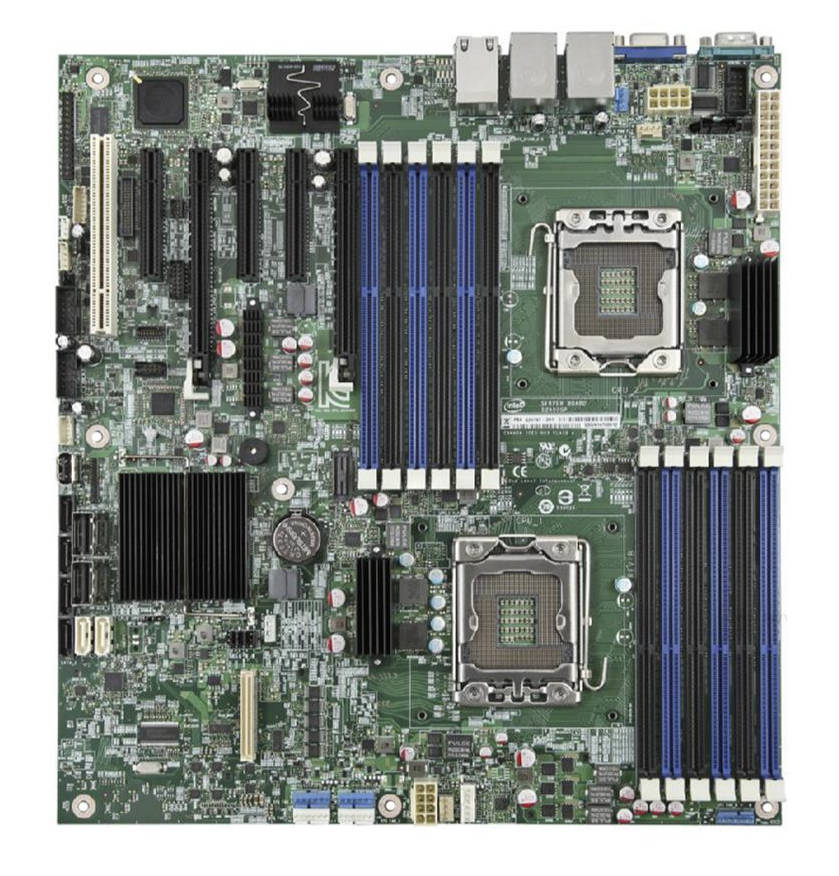
At launch, LGA1356 was found only in workstations and entry‑level servers from vendors like HP (ProLiant series), Dell (PowerEdge series) and IBM. Official motherboards were based on Intel C602, C602J or C606 chipsets and offered true triple‑channel memory mode plus support for ECC REG DDR3 server memory. However, for a typical home user these boards are a questionable choice: they often have non‑standard form factors, proprietary power connectors and require custom cooling. On top of that, such models can still be relatively expensive, and given the age of the platform and its modest performance by modern standards, the purchase is not always justified.
Chinese motherboards and “X79‑1356”
The socket received a second life thanks to Chinese brands (Huananzhi, Machinist, Qiyida), which flooded the market with boards sold under the generic marketing name “X79.” It’s important to understand that there is no real X79 chipset on these boards — they use old desktop chipsets (H61, B75) or mobile chipsets (HM65/HM70) instead. Because of this, functionality is heavily cut down: such models may lack USB 3.0 or SATA III, and the triple‑channel memory mode is usually not implemented — you’re left with only two channels. The boards themselves are simplified as much as possible structurally, and little effort is put into the firmware, so you should be prepared for various software‑side quirks.
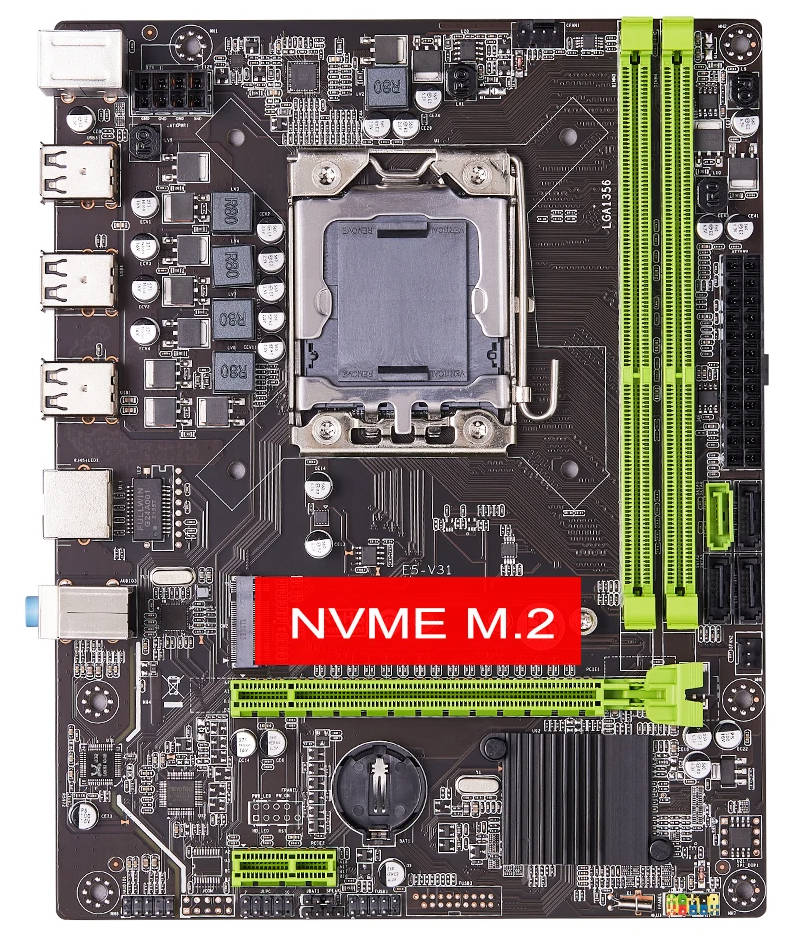
On the plus side, these boards almost always feature an M.2 slot, standard connectors and form factors, with entry‑level models starting at around $30.
Platform Relevance in 2026
By 2026, LGA1356 has firmly moved into the category of “ultra‑budget crisis solution.” While it was a solid mid‑range option at the time of its release, today it’s more a way to assemble a working PC for the price of a couple of grocery runs. But is it worth it?
Performance and workloads
Due to the reduced number of memory channels (Chinese boards most often have only two) and relatively low clock speeds, processors for 1356 perform worse than CPUs with a similar core count on LGA2011. And even the most budget LGA2011‑3 setups easily leave 1356 behind.
- Office and multimedia: here the platform holds up well. YouTube in 4K, office work, dozens of browser tabs — multi‑core Xeons handle these tasks without problems.
- Gaming: suitable mainly for well‑optimized games from a few years ago or for modern undemanding online titles (CS2, Dota 2, World of Tanks). In heavy modern AAA games, the platform struggles due to low memory bandwidth and weak single‑threaded performance. A sensible upper limit for GPUs would be a GTX 1060–1070, RX 580 or cards with similar performance.
Gaming performance of a Xeon E5‑2470 v2 paired with a GTX 1060:

Who is this for?
There’s really only one case where buying into LGA1356 makes sense in 2026: an extremely tight budget. This is a platform for situations where you need to build a system literally from scraps, using the absolute cheapest components you can find.
In all other scenarios, LGA1356 loses to the “senior” LGA2011 socket. The price gap between them has shrunk to almost nothing, yet 2011 offers four memory channels, more powerful CPUs and a much better selection of motherboards. In the end, LGA1356 is a “neutered” version of the classic Chinese recycle platforms: a bit cheaper, but noticeably weaker. It’s worth buying only out of curiosity or when every cent counts and you needed a PC “yesterday.”

Written by
Senior Hardware Specialist proving you don't need top-tier gear to game. Expert in smart upgrades and budget-friendly PC restoration.