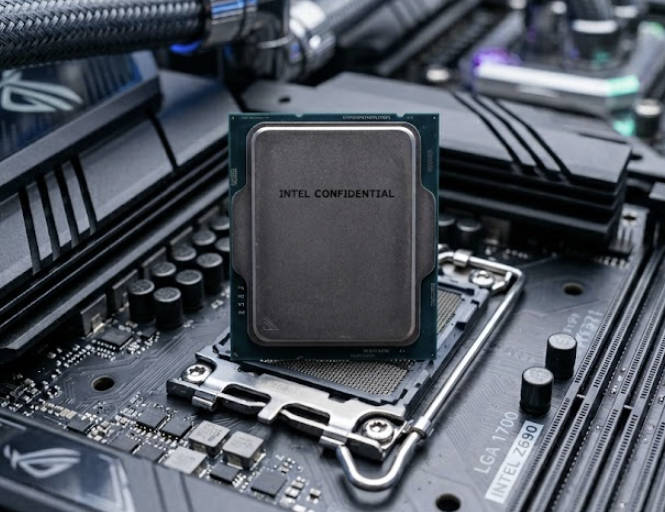
Intel Engineering Samples (ES) and Qualification Samples (QS) are pre-production CPU versions produced months ahead of the official retail launch. They are intended for industry partners—motherboard manufacturers, OEM system builders, BIOS developers, and others—for testing, platform validation, and compatibility debugging. Officially, Intel does not distinguish between ES and QS: both fall under the engineering sample category, remain Intel’s property, are not intended for retail sale, and carry no warranty. Yet, these chips inevitably end up for sale on marketplaces like AliExpress, Xianyu, Taobao, and eBay. The primary acquisition channels are leaks from production supply chains or resale by employees of OEM companies.
The main appeal of engineering samples is their low price point, combined with performance that often rivals retail hardware. However, the downsides are substantial: no official warranty, potential compatibility issues, rare microcode bugs, and other functional limitations. Additionally, early silicon revisions can lag noticeably behind final retail hardware in terms of raw performance.
Spotting an engineering sample is relatively simple: the IHS usually bears the inscription “Intel Confidential,” the familiar model name is replaced with a Q-spec code (e.g., Q0L4), and utilities like CPU-Z display “Engineering Sample” or lack a proper brand identifier entirely.
In practice, enthusiasts have established a clear hierarchy:
- ES1: The earliest revisions. These often feature noticeably reduced clock speeds and may contain bugs, disabled features (such as PCIe restrictions, memory limitations, or iGPU issues), or even incomplete core counts. These function as early-stage prototypes.
- ES2: Significantly refined samples. Stability and frequencies are much closer to final retail specifications.
- QS: The most mature samples that have passed qualification. In terms of specifications and reliability, they are very close to retail processors.
Below, we will thoroughly examine engineering samples for the LGA 1700 socket by generation, from 12th Gen (Alder Lake) to 14th Gen (Raptor Lake Refresh), reviewing their key features and popular models.
Important Disclaimer & Data Variance Warning
This reference guide is compiled entirely from public hardware databases, open-source enthusiast communities, and independent forum logs. Because Engineering (ES) and Qualification Samples (QS) are inherently non-retail, pre-production silicon, the specifications, clock speeds, and stepping behaviors listed in our tables may contain discrepancies and can vary from one specific batch to another.
Online marketplace sellers often mislabel listings. We provide this data strictly “as-is” for educational purposes. Consequently, we hold absolutely no responsibility for hardware inaccuracies, incorrect marketplace descriptions, or sudden compatibility failures. Proceed entirely at your own risk.
12th Generation Engineering Samples (Alder Lake)
On marketplaces like AliExpress and Taobao, sellers often slap the “ES” label on anything remotely pre-release. However, within the 12th Generation, there is a strict dividing line based on stepping (silicon revision), which splits processors into two completely different categories:
- ES (Steppings A0 / B0 / G0): Unrefined silicon. If the die is large (8+8 cores), its revision is called A0/B0. If the die is small (6 pure Performance cores), its revision is called G0.
- QS (Steppings C0 / H0): Close retail analogs. The large die is refined to the stable C0 stepping, while the small die reaches H0 stepping. Everything works as intended here.
ES Version Specifications
| Q-Spec Code | Retail Equivalent | Die & Stepping | Cores / Threads | Base Clock | Max Turbo | Notes |
|---|---|---|---|---|---|---|
| QXLB | i9-12900K | Large (B0/A0) | 16 (8P+8E) / 24 | 1.2 GHz | 5.1 GHz | Top PCIe 5.0 slot disabled. Weak IMC. |
| QX7H | i9-12900KF | Large (B0/A0) | 16 (8P+8E) / 24 | 1.2 GHz | 5.1 GHz | Top PCIe 5.0 slot disabled. Weak IMC. No iGPU. |
| QX7E | i9-12900K | Large (B0/A0) | 16 (8P+8E) / 24 | 1.3 GHz | 5.3 GHz | Top PCIe 5.0 slot disabled. Weak IMC. |
| QXJB | i9-12900K | Large (B0/A0) | 16 (8P+8E) / 24 | 1.2 GHz | 4.0 GHz | Extremely early ES2 revision. Unlocked multiplier, but highly unstable IMC (Memory Controller) and severe PCIe bugs. |
| QXJE | i9-12900K | Large (B0/A0) | 16 (8P+8E) / 24 | 1.4 GHz | 5.4 GHz | Popular first-wave ES chip. High power consumption and heat. |
| QX7J | i9-12900F | Large (B0/A0) | 16 (8P+8E) / 24 | 1.0 GHz | 4.0 GHz | Locked multiplier. Early large B0 die with disabled integrated graphics (No iGPU). Top PCIe 5.0 slot disabled. |
| QXQ3 | i9-12900 | Large (B0/A0) | 16 (8P+8E) / 24 | 1.2 GHz | 4.6 GHz | Locked multiplier. Hard 65W TDP power limit. |
| QXQ4 | i7-12700 | Large (B0/A0) | 12 (8P+4E) / 20 | 1.2 GHz | 4.4 GHz | 4 P-cores instead of 8 may be disabled on early sub-revisions. Check with the seller. |
| QXDY | i5-12600 / 12500 | Large (B0/A0) | 6 (6P+0E) / 12 | 1.4 GHz | 4.0 GHz | Large B0/A0 die with disabled E-cores. Runs hotter than retail i5. |
| QYGE | i5-12600 | Small (G0) | 6 (6P+0E) / 12 | 2.4 GHz | 4.4 GHz | Native 6-core G0 die. No PCIe 5.0 slot. Better efficiency than QXDY. |
| QY50 | i5-12500 | Small (G0) | 6 (6P+0E) / 12 | 2.4 GHz | 4.3 GHz | Native 6-core G0 die. No PCIe 5.0 slot. Better efficiency than QXDY. |
| QYGC | i5-12500 | Small (G0) | 6 (6P+0E) / 12 | 2.4 GHz | 4.0 GHz | Native 6-core G0 die. Locked multiplier. No PCIe 5.0 slot from CPU. Features functional UHD 770 iGPU. |
| QYGD | i5-12500T | Small (G0) | 6 (6P+0E) / 12 | 1.6 GHz | 4.2 GHz | Energy-efficient low-power T-series ES. Hard 35W TDP power limit. |
| QXW5 | i5-12400F | Small (G0) | 6 (6P+0E) / 12 | 2.2 GHz | 4.4 GHz | Native 6-core G0 die. No PCIe 5.0 slot from CPU. Integrated graphics physically disabled (No iGPU). |
ES version features (steppings A0/B0/G0):
- CPU PCIe x16 lanes are disabled: A discrete graphics card can only run via a chipset-routed slot (usually limited to PCIe 4.0 x4), or through an M.2-to-PCIe adapter (since the x4 lanes directly from the CPU typically work).
- Finicky memory controller (IMC): Maximum stable frequencies are noticeably lower than final retail CPUs. ES models are highly sensitive to RAM modules and often require manual timing adjustments.
- Overclocking specifics: The multiplier on K-version engineering samples is adjustable but has a lower hard cap (usually no higher than 4.6 GHz). However, these processors respond excellently to BCLK overclocking on motherboards equipped with an external clock generator.
- Increased power consumption and heat: The manufacturing process at this stage is not yet refined. The silicon requires elevated voltages for stable operation, meaning even entry-level 6-core models can run as hot as full 125W processors. Undervolting is mandatory here.
- Unstable iGPU: The integrated UHD 770 / 730 graphics on the A0 stepping often exhibit artifacts or require the manual installation of older driver versions.
- Display and software issues: In CPU-Z and Task Manager, the processor has no official name and displays as “Genuine Intel(R) CPU 0000.”
QS Version Specifications
| Q-Spec Code | Retail Equivalent | Die & Stepping | Cores / Threads | Base Clock | Max Turbo | Notes |
|---|---|---|---|---|---|---|
| QY5V | i9-12900KF | Final (C0) | 16 (8P+8E) / 24 | 3.2 GHz | 5.2 GHz | Full retail behavior. No iGPU. Fully supports multiplier and RAM overclocking. |
| QY5U | i9-12900K | Final (C0) | 16 (8P+8E) / 24 | 3.2 GHz | 5.2 GHz | Full retail behavior. Fully functional UHD 770 iGPU. |
| QYHQ | i7-12700KF | Final (C0) | 12 (8P+4E) / 20 | 3.6 GHz | 5.0 GHz | Full retail behavior. No iGPU. Fully supports multiplier and RAM overclocking. |
| QYHP | i7-12700K | Final (C0) | 12 (8P+4E) / 20 | 3.6 GHz | 5.0 GHz | Full retail behavior. Fully functional UHD 770 iGPU. |
| QY66 | i5-12600KF | Final (C0) | 10 (6P+4E) / 16 | 3.7 GHz | 4.9 GHz | Full retail behavior. No iGPU. Fully supports multiplier and RAM overclocking. |
| QY65 | i5-12600K | Final (C0) | 10 (6P+4E) / 16 | 3.7 GHz | 4.9 GHz | Full retail behavior. Fully functional UHD 770 iGPU. |
| QYHW | i5-12400 | Final (C0) | 6 (6P+0E) / 12 | 2.5 GHz | 4.4 GHz | Harvested large C0 die (disabled E-cores). |
| QYVG | i5-12600 | Final (H0) | 6 (6P+0E) / 12 | 3.3 GHz | 4.8 GHz | Native small H0 die. Highly efficient, runs very cool. |
| QYHX | i5-12400 | Final (H0) | 6 (6P+0E) / 12 | 2.5 GHz | 4.4 GHz | Native small H0 die. Highly efficient, runs very cool. |
| QTVM | i5-12400 | Final (C0) | 6 (6P+0E) / 12 | 2.5 GHz | 4.4 GHz | Alternative first-wave QS code for i5-12400. Harvested large C0 die with disabled E-cores. Identical to QYHW. |
| QYVR | i3-12300 | Final (H0) | 4 (4P+0E) / 8 | 3.5 GHz | 4.4 GHz | Full retail behavior. Higher base clock and slightly larger L3 cache allocation than i3-12100. Fully functional. |
| QYVQ | i3-12100 | Final (H0) | 4 (4P+0E) / 8 | 3.3 GHz | 4.3 GHz | Full retail behavior. Budget 4-core configuration. Fully functional UHD 730 iGPU and PCIe lines. |
QS version features (steppings C0 and H0):
- Full PCIe lanes: No workarounds needed for graphics cards. The primary graphics slot works in standard mode (including PCIe 5.0 speed).
- Normal memory operation: The memory controller functions properly. DDR4 easily handles popular 3200–3600 MHz speeds in Gear 1 mode, while DDR5 runs at its rated high speeds.
- Factory frequencies and limits: Turbo Boost algorithms, power limits (PL1/PL2), and operating voltages match retail specifications in most cases. Heat output and power consumption are standard.
- Stable integrated graphics: The iGPU works flawlessly out of the box with any official Intel drivers.
- Excellent compatibility: Unlike ES samples that require older microcode versions, QS variants boot without issues on virtually any tier-one motherboard, even with the latest BIOS versions.
- Official system name: Unlike ES samples, these processors are identified by their real retail names (e.g., Intel Core i5-12400 or i9-12900K). CPU-Z merely adds a modest “(ES)” notation in one of the text fields, but Windows and games see it as a regular retail CPU.
13th Generation Engineering Samples (Raptor Lake)
| Q-Spec Code | Retail Equivalent | Stage & Revision | Cores / Threads | Base Clock | Max Turbo | Notes |
|---|---|---|---|---|---|---|
| Q0D8 | i9-13900 ES1 | Early ES1 | 24 (8P+16E) / 32 | 1.1 GHz | 4.0 GHz | Very early silicon. Severely downclocked, hard 65W limit, low IPC. Poorly suited for modern gaming. |
| Q0L4 | i9-13900 / 13900K ES2 | Mature ES2 | 24 (8P+16E) / 32 | 1.4 GHz | 4.6 GHz | Locked multiplier. PCIe Gen4 lines are stable. Supports high power limits (~200W+). Manual undervolting recommended. |
| Q0PU | i9-13900K ES | Mature ES2 | 24 (8P+16E) / 32 | 1.4 GHz | 5.0 GHz | Unlocked multiplier. PCIe Gen4 stable. Requires fine-tuning and E-core undervolting to mitigate thermal throttling. |
| Q0NT | i9-13900K ES | Mature ES2 | 24 (8P+16E) / 32 | 1.4 GHz | 5.0 GHz | Identical behavior to Q0PU. Unlocked multiplier, stable PCIe Gen4. High thermal load under AVX workloads. |
| Q1HM | i9-13900K Late ES | Late ES2 | 24 (8P+16E) / 32 | 2.2 GHz | 5.5 GHz | Late-stage revision. Mimics retail performance, IMC stability, and power management. Highly compatible with modern microcodes. |
| Q1HP | i9-13900F ES | Late ES2 | 24 (8P+16E) / 32 | 1.4 GHz | 4.8 GHz | F-series variant with physically disabled integrated graphics (No iGPU). Stable for multi-threaded host environments. |
| QYG4 | i9-13900K ES | Mature ES | 24 (8P+16E) / 32 | 1.4 GHz | 5.3 GHz | Unlocked multiplier. High power consumption. Aggressive E-core undervolting required to maintain stable thermal headroom. |
| Q0L7 | i7-13700K ES | Mature ES2 | 16 (8P+8E) / 24 | 1.6 GHz | 5.0 GHz | Unlocked multiplier. Fully operational PCIe Gen4 lines. Consistent performance under multi-threaded loads. |
| QYGA | i7-13700K ES | Mature ES | 16 (8P+8E) / 24 | 1.6 GHz | 5.0 GHz | Unlocked multiplier. Standard overclocking headroom. Requires precise Vcore voltage tuning. |
| Q0L9 | i7-13700F ES | Mature ES2 | 16 (8P+8E) / 24 | 1.5 GHz | 4.9 GHz | F-series variant (No iGPU). Multiplier is hardware-locked in specific production batches. |
| Q0L5 | i7-13700 ES | Early ES2 | 16 (8P+8E) / 24 | 1.5 GHz | 4.5 GHz | Locked multiplier. Entry-level 16-core configuration. Marginally lower IPC compared to final retail silicon. |
| Q0WY | i5-13600K ES | Mature ES | 14 (6P+8E) / 20 | 2.2 GHz | 4.8 GHz | Unlocked multiplier. PCIe Gen4 stable. Reliable mid-range option for gaming setups after manual ring/voltage tuning. |
| Q0PS | i5-13400 ES | Mature ES | 10 (6P+4E) / 16 | 1.8 GHz | 4.6 GHz | Budget 10-core engineering sample. Fully functional UHD 730 integrated graphics. |
| Q0PV | i9-13900T ES | Energy Efficient | 24 (8P+16E) / 32 | 1.0 GHz | 4.7 GHz | Low-power T-series variant. Hardware-locked to a strict 35W TDP limit. Suitable for low-profile SFF/ITX builds. |
13th Generation engineering sample features:
- Better overall compatibility: These chips offer significantly better compatibility than their 12th Gen predecessors. Most models boot without serious issues.
- CPU PCIe lanes work normally, though in most cases they are limited to Gen 4.0 mode instead of Gen 5.0. Discrete graphics cards and other expansion hardware can be used without problems.
- Performance is very close to retail versions: The difference usually falls within a tight 2–8% margin after fine-tuning.
- Overclocking is restricted to K-series chips: On non-K versions (which make up most ES samples), multiplier adjustments are completely disabled. Note that BCLK overclocking is also blocked for non-K versions on both 13th and 14th Generation platforms.
- Memory controller stability: More stable than the 12th Generation, but the IMC can still be sensitive to specific RAM ICs and module layouts.
- Elevated E-core voltages: A common characteristic of 13th Gen ES silicon. This leads to increased heat output and potential BSODs under heavy multi-threaded loads, which can be mitigated by applying an E-core voltage offset.
- iGPU operational status: The integrated graphics work on most samples, but on certain specific models or early revisions, the iGPU may be factory-disabled or unstable.
- High stock power consumption: Out-of-the-box power draw can be high, especially if the motherboard removes PL1/PL2 limits by default. Manual power limiting and undervolting are highly recommended.
- Lower silicon lottery risk: They suffer less from the silicon lottery compared to 12th Gen options. These engineering samples are mature enough for daily use in a primary system.
14th Generation Engineering Samples
| Q-Spec Code | Retail Equivalent | Stage & Revision | Cores / Threads | Base Clock | Max Turbo | Notes |
|---|---|---|---|---|---|---|
| QDF4 | i9-14900K QS | Mature QS / Final | 24 (8P+16E) / 32 | 3.2 GHz | 6.0 GHz | Unlocked multiplier and SA voltage. Strong IMC. |
| Q37Q | i9-14900 QS | Final QS (Locked) | 24 (8P+16E) / 32 | 2.0 GHz | 5.8 GHz | Locked multiplier. Locked SA Voltage (limits DDR4 Gear 1 max frequency to ~3600 MHz). |
| Q3RX | i7-14700 QS | Mature QS (Locked) | 20 (8P+12E) / 28 | 2.1 GHz | 5.4 GHz | Locked multiplier. Locked SA Voltage (limits DDR4 Gear 1 max frequency to ~3600 MHz). |
| Q37P | i9-14900T QS | Low Power QS | 24 (8P+16E) / 32 | 1.1 GHz | 5.5 GHz | Hardwired 35W TDP limit. Highly optimized voltage curves. Interesting option for compact ITX systems or homelab/NAS builds. |
| Q3JR | i7-14700T QS | Low Power QS | 20 (8P+12E) / 28 | 1.3 GHz | 5.2 GHz | Hardwired 35W TDP limit. Highly optimized voltage curves. Perfect for ITX/NAS. |
| Q37Y | i5-14500 QS | Final QS (Locked) | 14 (6P+8E) / 20 | 2.6 GHz | 5.0 GHz | Refreshed Raptor Lake stepping. High efficiency, locked SA voltage. |
| Q37X | i5-14500T QS | Low Power QS | 14 (6P+8E) / 20 | 1.7 GHz | 4.8 GHz | Hardwired 35W TDP limit. Highly optimized voltage curves. Interesting option for compact ITX systems or homelab/NAS builds. |
| Q37T | i5-14400 QS | Final QS (Locked) | 10 (6P+4E) / 16 | 2.5 GHz | 4.7 GHz | Refreshed Raptor Lake stepping. Locked SA voltage. |
| Q3ZE | i5-14400F QS | Final QS (No iGPU) | 10 (6P+4E) / 16 | 2.5 GHz | 4.7 GHz | Refreshed Raptor Lake stepping. Locked SA voltage. No IGPU. |
14th Generation engineering sample features:
- Highly similar to the 13th Generation: They share the same underlying steppings and architecture. The main differences are slightly more aggressive out-of-the-box clock speeds and increased E-core counts on specific models.
- Excellent compatibility with existing 600 and 700-series motherboards. There are virtually no widespread issues regarding PCIe lanes, memory training, or system booting.
- Performance is on par with or slightly above late-batch 13th Generation QS samples. The performance delta compared to retail silicon is minimal, usually sitting between 2–7%.
- Overclocking limitations remain identical to those of the 13th Generation.
- Power consumption and temperatures may be slightly higher due to the increased factory frequencies. Just like with previous generations, undervolting effectively mitigates the extra heat.
- Stable integrated graphics: The iGPU works reliably on the vast majority of available samples.
- Refined memory controller: This is one of the best IMCs on the LGA 1700 platform, handling high-frequency DDR5 kits exceptionally well.

Written by
Senior Hardware Specialist proving you don't need top-tier gear to game. Expert in smart upgrades and budget-friendly PC restoration.