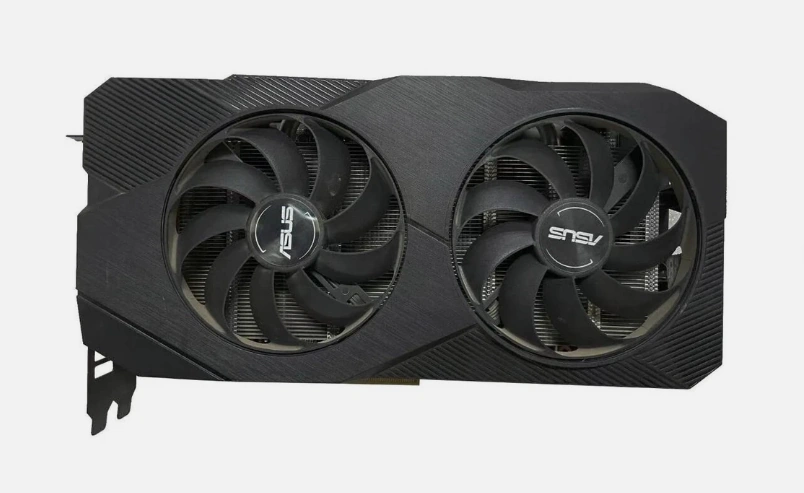
The CMP 40HX is NVIDIA’s mining version of a Turing gaming card, released in 2021. Inside is the TU106 chip with 2176 CUDA cores and 8 GB of GDDR6 on a 256-bit bus, running at the same clocks as an RTX 2060 Super. NVIDIA blocked gaming in three ways: the official driver doesn’t enable DirectX or Vulkan on it, the card’s video outputs don’t work, and its PCIe bus is wired for four lanes at PCIe 1.1 speed.
The first two are easy to get around. A modified driver unlocks 3D, and the picture goes to your monitor through the CPU’s integrated graphics or a second card. The bus is the real problem: out of the box the card gets about 1 GB/s, a sixteenth of what an RTX 2060 Super has, and that holds it back in most games. Solder in the missing capacitors next to the PCIe connector and all 16 lanes come alive. After that, the CMP 40HX plays close to an RTX 2060 Super, and used cards sell for around $100–150.
This guide covers what your platform needs, which driver to install, the x16 soldering mod and how to check it, a new experimental unlock that brings back DLSS, and how the card actually performs in games.
Table of Contents
CMP 40HX vs RTX 2060 Super and RTX 2070: What’s Different
The patched driver shows the card as an “RTX 2070”, and some spec databases still list 2304 cores. Don’t let that fool you: every CMP 40HX has 34 of the chip’s 36 SMs enabled, the same configuration and clocks as an RTX 2060 Super.
| CMP 40HX | RTX 2060 Super | RTX 2070 | |
|---|---|---|---|
| GPU | TU106 | TU106 | TU106 |
| CUDA cores | 2176 | 2176 | 2304 |
| Clocks (base / boost) | 1470 / 1650 MHz | 1470 / 1650 MHz | 1410 / 1620 MHz |
| Memory | 8 GB GDDR6, 256-bit, 14 Gbps | 8 GB GDDR6, 256-bit, 14 Gbps | 8 GB GDDR6, 256-bit, 14 Gbps |
| Bus | PCIe 1.1 x4 (~1 GB/s), x16 after soldering (~4 GB/s) | PCIe 3.0 x16 (~16 GB/s) | PCIe 3.0 x16 (~16 GB/s) |
| Video outputs | DVI and DisplayPort on the bracket, disabled | yes | yes |
| NVENC | yes, with the right driver | yes | yes |
| Tensor cores (DLSS) | throttled, no DLSS out of the box | full speed | full speed |
| Power | 185 W, one 8-pin | 175 W, one 8-pin | 175 W, one 8-pin |
| Device ID | 10DE:1F0B | 10DE:1F06 | 10DE:1F02, 10DE:1F07 |
In silicon the CMP 40HX is a complete RTX 2060 Super. What it loses in games comes from the bus and from what NVIDIA locked in firmware, not from the chip.
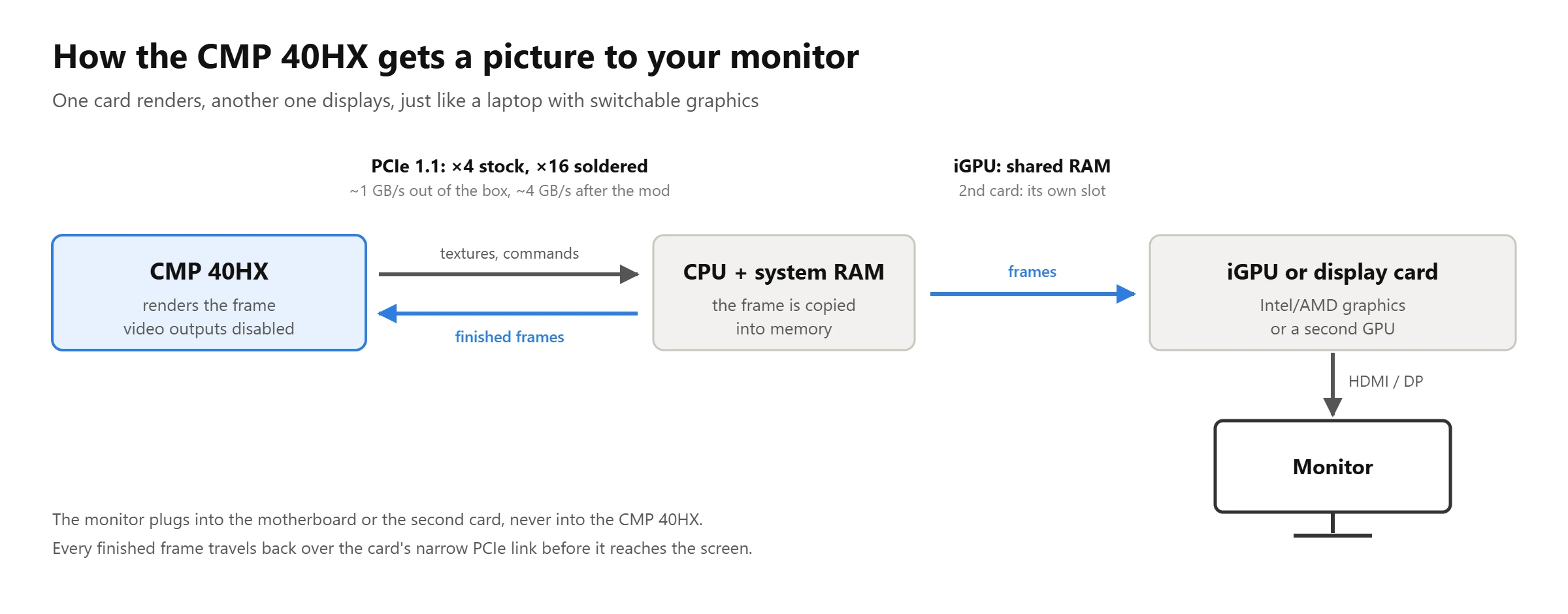
The ASUS board is borrowed from a gaming card, so its bracket still carries DVI and DisplayPort connectors. They’re dead: NVIDIA disabled display output, and neither a BIOS flash nor soldering brings it back. The monitor always goes into the integrated graphics or a second card.
Unlike the Pascal mining cards (P106-100, P104-100), the CMP 40HX has a working video encoder: owners record and stream through NVENC in OBS and ShadowPlay, but it only works with the right driver.
The RT cores are there, but ray tracing runs roughly two to three times slower than this chip should manage, so it’s of little use. The tensor cores are throttled in firmware to a small fraction of their speed, so DLSS isn’t available out of the box. An experimental unlock described below brings them back.
Other CMP Mining Cards
| Card | Chip | CUDA cores | Memory | Closest GeForce | For gaming |
|---|---|---|---|---|---|
| CMP 30HX | TU116 | 1408 | 6 GB GDDR6, 192-bit | GTX 1660 Super | yes, budget |
| CMP 40HX | TU106 | 2176 | 8 GB GDDR6, 256-bit | RTX 2060 Super | the best of the family |
| CMP 50HX | TU102 | 3584 | 10 GB GDDR6, 320-bit | between RTX 2080 and 2080 Ti | only with a 2026 unlock |
| CMP 70HX | GA104 | 6144 | 8 GB GDDR6X, 256-bit | RTX 3070 Ti | no |
| CMP 90HX | GA102 | 6400 | 10 GB GDDR6X, 320-bit | cut-down RTX 3080 | experimental |
| CMP 170HX | GA100 | 4480 | 8 or 10 GB HBM2e | A100 (compute card) | no |
All of them ship with PCIe 1.1 x4. On the 30HX, 40HX, 50HX and 90HX the missing lanes can be soldered in; the difference is in what NVIDIA locked in firmware on top of that.
- CMP 30HX is the same idea one class lower: a mining GTX 1660 Super that needs the same driver and the same soldering. Owners report that its NVENC doesn’t work. Our CMP 30HX guide covers it, including its own PCIe 2.0 unlock that leaves Secure Boot on.
- CMP 50HX has its FP32 throughput cut to 1/24, so out of the box games crawl no matter how many lanes you solder. Unlocks published in 2026 restore full compute speed; there are few game tests yet.
- CMP 70HX is capped in 3D by software: one owner measured 13 FPS in Cyberpunk 2077 at 1080p, and a shunt mod didn’t help.
- CMP 90HX got an EFI unlock for Windows in August 2026 (cmp90hx-unlock-for-windows). It’s early days, and even its author calls the card a compute card first.
- CMP 170HX is built on the A100 data center chip and runs in compute-only mode, so games are out of the question.
What You Need to Game on a CMP 40HX
Four things: a device that sends the picture to your monitor, Windows 10 or 11, a modified driver and, realistically, a soldering iron (or a card that has already been soldered). The CMP 40HX renders the frame and the integrated graphics or a second card displays it, just like a laptop with a discrete GPU.
Windows 11 is the better choice. It lets you pick the GPU for every game in the system settings, and that works even with a second discrete card. In Windows 10 the standard way is the NVIDIA Control Panel: Manage 3D settings → Preferred graphics processor → High-performance NVIDIA processor. It works with integrated graphics, but not always as well as on Windows 11: some games ignore the setting, and with a second discrete card it often doesn’t work at all.
If that doesn’t help, try select_default_GPU. This small open-source batch script (GitHub) fixes the most common case of a game running on the wrong GPU. Its first option turns on the default high-performance GPU and per-app GPU settings that Windows 10 has but hides. The second writes the mining card into the registry as the default high-performance DirectX adapter. The third makes OpenGL programs use the NVIDIA driver instead of the integrated graphics; it needs administrator rights and a reboot, and doesn’t work while Microsoft’s OpenCL and OpenGL Compatibility Pack is installed. Owners report that it got Windows to accept the mining card as the high-performance GPU and moved OpenGL apps like FurMark onto it, though a few older games still started on the integrated graphics.
Which Platforms Work
| Platform | Verdict | Notes |
|---|---|---|
| Intel 6th–14th gen with iGPU (LGA1151, 1200, 1700) | best option | current iGPU drivers, DirectX 12 works |
| Intel Haswell (LGA1150) | works | DirectX 12 only with an older Intel driver, see Pitfalls |
| Intel Ivy Bridge (LGA1155) | at your own risk | Windows 11 recommended, the iGPU has no DirectX 12 |
| Intel Sandy Bridge (LGA1155) | not recommended | can be made to work, with serious limitations |
| AMD AM4 with an APU (Ryzen G) | works | some APUs give the graphics slot only x8, so a soldered card runs at PCIe 1.1 x8 (~2 GB/s) |
| X79, X99 and any CPU without iGPU | works with a second card | see “No Integrated Graphics” below |
A soldered card needs a slot that is x16 electrically. On budget boards the second long slot is often wired as x4, and then the soldering gains you nothing. Use the top slot connected to the CPU.
Your CPU needs AVX. This has nothing to do with the card, but it bites cheap builds all the time. Pentium and Celeron chips up to 10th gen (G4560, G5400, G6400 and the like) and first-gen Core i3/i5/i7 lack AVX, and modern games either refuse to start or spend hours compiling shaders. Core i3/i5/i7 from Sandy Bridge on, every Xeon E3 and the Xeon E5 chips for X79/X99 have it.
CMP 40HX Driver
The official NVIDIA driver installs on the CMP 40HX, but only enables compute: DirectX and Vulkan are locked for this card. The lock is purely in software, and there are two ways around it.
- NVIDIA-patcher by dartraiden (GitHub) changes a few bytes in the official driver files. It’s open source, well documented, and it’s the one to use if you need NVENC: owners stream and record with it in OBS. The patched files are signed with a self-made certificate, so some antivirus programs flag them and anti-cheat systems often refuse to load them (see Pitfalls).
- RainCandy Technology Special Edition (GitHub) is a ready-made installer that adds its root certificate by itself and walks you through errors. It’s also the one to look at for anti-cheat games (see Pitfalls). Two catches: owners report it has no NVENC, and it’s signed with leaked certificates that anti-cheat systems may not trust, up to and including an account ban.
Which Version to Install
The right version depends on what drives your monitor. Data from the patcher’s Windows guide as of November 2026:
| Display output through | Driver version |
|---|---|
| Intel or AMD integrated graphics | 621.14 |
| AMD graphics card | 621.14 |
| NVIDIA GTX 16, RTX and newer | 621.14 |
| NVIDIA GTX 900/10 series, GT 1030 | 581.94 |
| NVIDIA Kepler (GT 710/730) | 472.12 |
| Two CMP 40HX in SLI | not supported |
This is one of the CMP 40HX’s real advantages over the P106-100 and P104-100. NVIDIA still supports Turing in its current driver branches, while Pascal stopped at the 580 branch, so the CMP 40HX keeps getting new drivers, as long as the display card doesn’t hold it back.
Step-by-Step Installation
- Install the driver for your integrated graphics (or the second card) and make sure the picture comes through it.
- Download the official NVIDIA driver of the right version, the matching patched files and DDU. If you plan to stream, take the regular patched build, not the one prefixed “NVENC-NvFBC”: one owner reports it fails to install on the CMP 40HX.
- Unpack the driver with 7-Zip, replace the original files with the patched ones and add the patcher’s certificate as its Windows guide describes.
- Disconnect from the internet, or Windows Update will slip in its own driver. Remove the old NVIDIA driver with DDU and reboot.
- Run
setup.exefrom the unpacked folder, then reconnect. - Set the CMP 40HX as the high-performance GPU: in Windows 11 under Settings → System → Display → Graphics, in Windows 10 in the NVIDIA Control Panel → Manage 3D settings.
The monitor stays plugged into the integrated graphics or the second card the whole time, since the CMP 40HX has nowhere to plug it in.
If the Driver Won’t Install
- The installer doesn’t see the card or crashes. Install through Device Manager instead: Update driver → Browse my computer → point it to the unpacked driver folder.
- Code 43 in Device Manager. Most often the driver and the patch don’t match, the patcher’s certificate wasn’t added, or Windows Update has quietly replaced the patched driver with the official one. Remove everything with DDU and reinstall offline, double-checking that the patched files are for exactly your driver version.
- Blue screen right after installing. Turn off hardware-accelerated GPU scheduling (Settings → System → Display → Graphics), as the patcher’s guide recommends.
- The antivirus deleted files. Patched files trigger false positives now and then. The patcher’s author suggests adding
C:\Windows\System32\DriverStoreto the exclusions.
No Integrated Graphics: Second GPU, X79 and X99
The CMP 40HX works fine on X79 and X99, but Xeon E5 chips have no integrated graphics, so a second card has to send the picture to the monitor. The same goes for Intel F-series CPUs and Ryzen without a G. To choose which card renders the game, Windows 11 is the easier option. Windows 10 is more troublesome here, but select_default_GPU (see above) often fixes it.
Which Card to Use for Display
Two NVIDIA cards in one system share a single driver version, so the display card decides how new a driver the CMP 40HX gets. An AMD card or an NVIDIA GTX 16/RTX card lets it run the newest version, a Maxwell or Pascal card holds it back a step, and a Kepler card drags it down to a driver from 2021 (versions are in the table above).
- AMD (RX 550 or similar) is the most trouble-free option. Drivers from two vendors don’t get in each other’s way, and the CMP 40HX gets the newest driver.
- GT 1030 or another Pascal/Maxwell card is fine for now, though it holds the CMP 40HX at the 580 branch (581.94). Also expect the usual conflicts between two NVIDIA cards.
- GT 710/730 (Kepler) are the most common “spare” cards and the worst choice. They pull the whole system down to the old 472.12, and some modern games won’t start on it. Fermi cards such as the GT 610 (and older GT 730 versions) don’t work at all: their last driver, 391.35, predates Turing.
- The display card needs DirectX 12 in hardware. Kepler cards like the GTX 650 Ti report DirectX 12 only on paper (feature level 11_0), and with one of them driving the display, DirectX 12 games fail even though the CMP 40HX supports it.
- Two NVIDIA cards and Windows won’t let you choose. Owners with a GTX 670 or GTX 960 for display saw the CMP 40HX missing from the Graphics settings and games running on the display card. The fix is the EnableMsHybrid registry value: 1 on one card and 2 on the other, then reboot (details in issue #57), or let select_default_GPU set the high-performance adapter for you.
The display card’s slot matters too, since it receives every finished frame. An x1 riser on a PCIe 2.0 chipset slot caps 1080p at roughly 40 FPS, whatever the CMP 40HX can render. Here’s the math behind that from our P106-100 guide; in short, give the display card at least an x4 slot.
Bottom line for X79 and X99: add the price of a second card to the CMP 40HX. It makes sense if a suitable card is already sitting in a drawer; otherwise compare the total with a used RTX 2060 Super.
PCIe x4 Out of the Box: Why the Bus Decides Everything
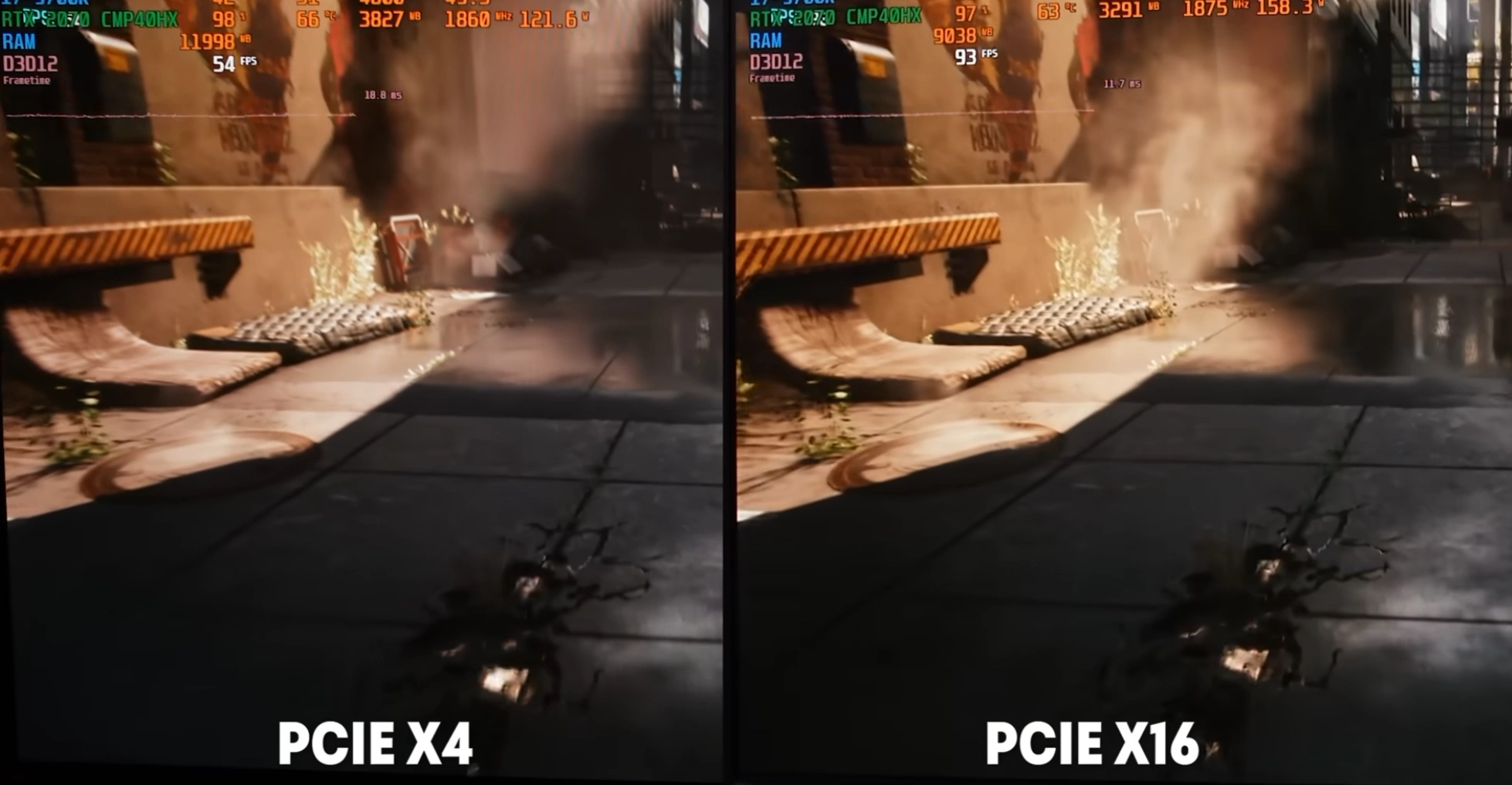
An RTX 2060 Super talks to the system over PCIe 3.0 x16, about 16 GB/s. A stock CMP 40HX gets PCIe 1.1 x4: a nominal 1 GB/s and about 0.8 GB/s in practice. The chip supports 16 lanes, and the board has traces for all of them, but NVIDIA left out the capacitors on 12 lanes. Soldering them in gives PCIe 1.1 x16, about 4 GB/s, the same as the P106-100 has from the factory.
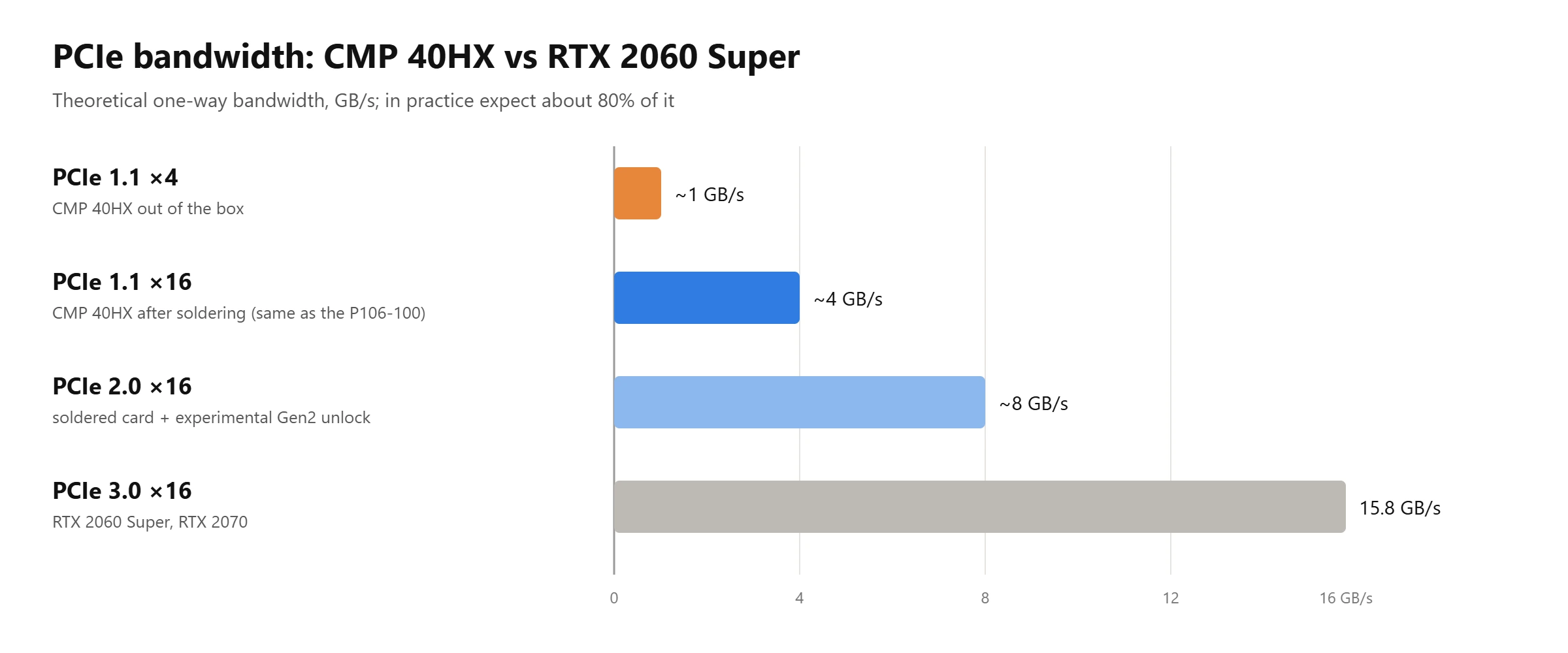
The bus carries two kinds of traffic, and a narrow link hurts both:
- Finished frames going out. The card has no working outputs, so every frame travels back over the bus to the integrated graphics or the display card. A 1080p frame is about 8.3 MB, so 60 FPS takes 0.5 GB/s and 144 FPS takes 1.2 GB/s.
- Data coming in. Textures and geometry that the game streams while you play. When a game loads a new area or streams textures constantly, as most Unreal Engine 5 games do, the card waits for data, and you see it as stutters and low 1% lows rather than lower average FPS.
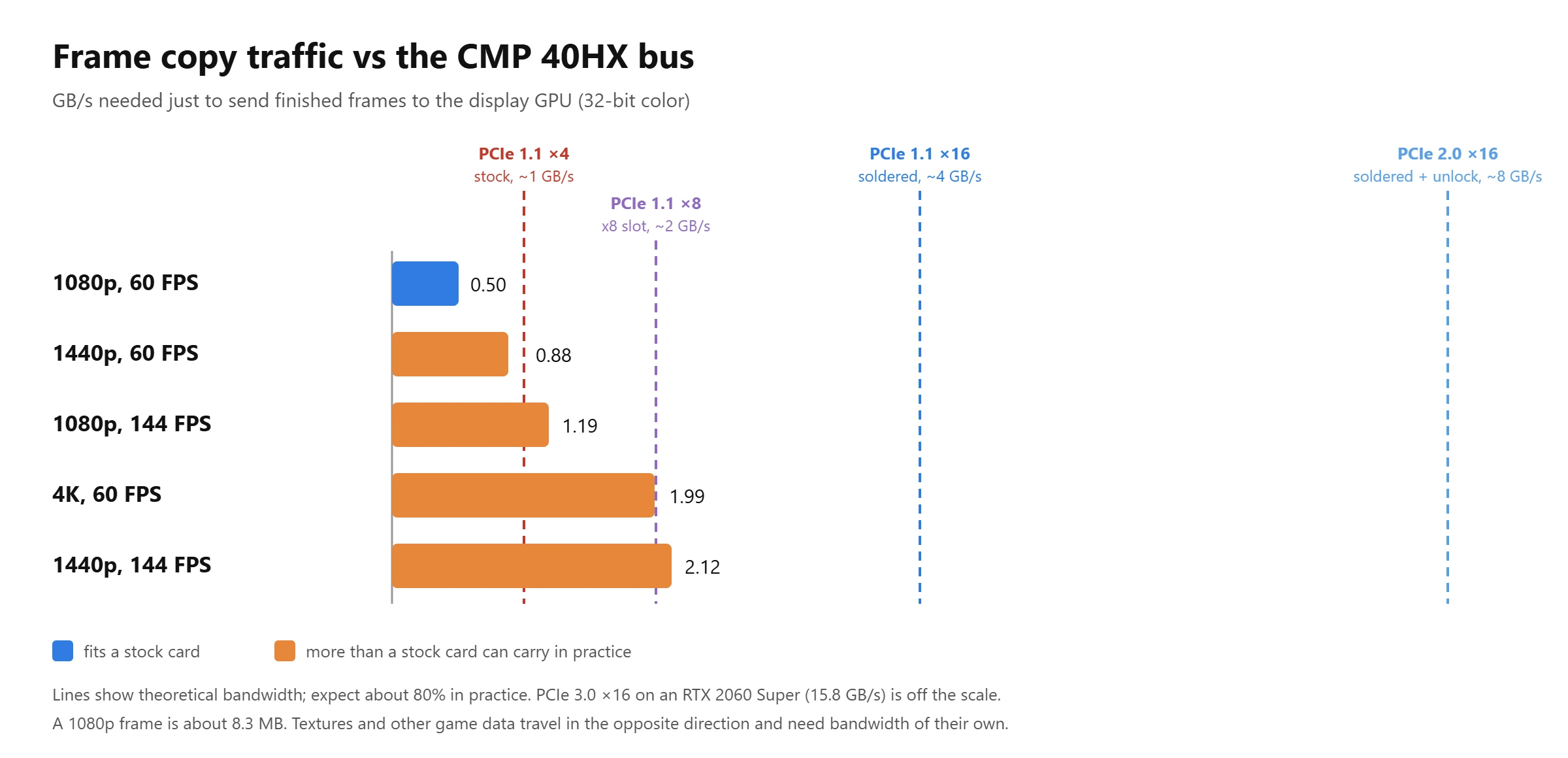
Without soldering, the CMP 40HX is in the same spot as the P104-100, just with a faster chip waiting on the same narrow bus. The bus sets a hard ceiling: even in the lightest game, a stock card can’t send more than about 100 frames per second to the display at 1080p, or about 55 at 1440p. That’s the upper limit, not what you’ll get. In modern games the card also keeps waiting for textures and other data, so real frame rates are lower and much less even, and open-world games stutter. Much of what the chip can do simply goes unused. An unsoldered card makes sense only as a starting point: plan for the soldering, or buy one that’s already been done.
Soldering the CMP 40HX to PCIe x16
This is the mod that turns the CMP 40HX into a proper gaming card. It’s well proven: owners have been doing it since 2023, and many cards are now sold already modified. You don’t touch the power circuits or the firmware, only the signal lines between the connector and the chip.
What to Solder
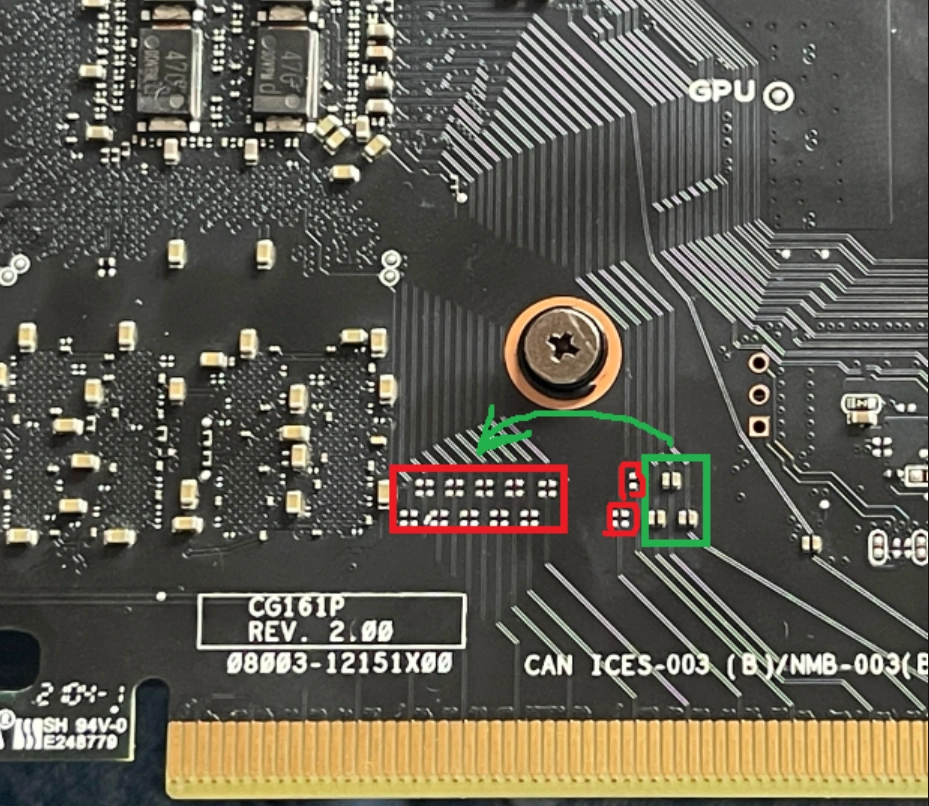
Each PCIe lane needs small AC coupling capacitors on its signal lines. On the CMP 40HX they are fitted only on the first four lanes. The pads for the other twelve sit next to the PCIe connector, along the traces running toward the chip, and they’re easy to spot as rows of empty pads beside the populated ones.
- Fill every empty pad along the lanes.
- Size 0402 (1.0 × 0.5 mm), 220 nF, X7R ceramic, 16 V or more; 100 nF is also reported to work. Buy them from a proper electronics supplier: one owner measured capacitors well under 220 nF on a card sold as soldered, and it stayed at x4. Order a few spares, because parts this small get lost easily.
- Tools: a soldering iron with a fine tip or a hot air station, flux, fine tweezers and some magnification.
The video shows the whole process on an ASUS CMP 40HX, then the driver patch and the first games:

Cost and Risks
If you’ve never soldered SMD parts, don’t learn on this card: any repair shop that works on phones or laptops will do it.
- What can go wrong: a lifted pad, a solder bridge, or a static discharge. A pad torn off the board is the only really bad outcome, so don’t overheat and don’t pull on parts.
- A bad joint isn’t fatal. If the card trains at x8 or x4 after the mod, one or more capacitors aren’t making contact. Reflow them and check again. If the card stays at x4 with every pad filled, measure the capacitors you used first; there are also unconfirmed claims of later board revisions where the mod doesn’t work.
- The link stays at PCIe 1.1. Soldering quadruples the bandwidth by adding lanes, but each lane still runs at PCIe 1.1 speed, and no BIOS flash changes that. So far the only way past it is the experimental software unlock below, and it stops at PCIe 2.0. Ignore listings and firmware that promise “PCIe 3.0” or working video outputs.
How to Check the Result
Open GPU-Z and look at the Bus Interface line. The part before the @ is what the card supports, the part after it is the link you actually have. A stock card shows x4 after the @; a properly soldered one in a full-width slot shows x16 1.1.
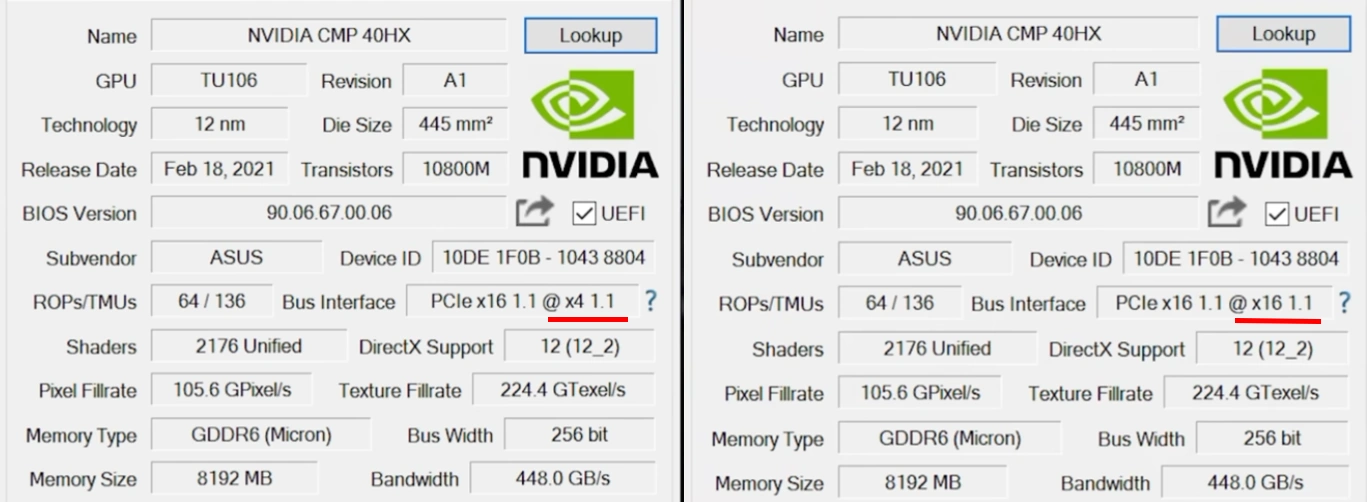
Don’t be confused if GPU-Z shows 3.0 or 4.0 before the @: some driver versions report the supported mode wrongly. Only what comes after the @ counts. If you see x8 there, either the slot is wired as x8 (common for second slots and on some APUs) or a joint needs redoing.
Buying a Card That’s Already Soldered
Modified cards are common on the secondhand market, usually marked “x16” in the listing, and they cost only a little more than stock ones. Before buying, ask for two things:
- a GPU-Z screenshot with “x16 1.1” after the @;
- a close-up photo of the board near the PCIe connector, on the side with the capacitor pads: all pads along the lanes should be populated, with neat joints and no burn marks or leftover flux.
Experimental: PCIe 2.0 and Tensor Core Unlock
In September 2026 enthusiasts published an open-source Windows tool that goes past what soldering can do: cmpunlocker, with ready Windows builds on its Releases page (v2.1.1 as of November 2026). A small EFI program runs before Windows starts and rewrites the card’s registers, and a helper retrains the PCIe link after you log in. Nothing is flashed, and the changes disappear when the power is cut.
- Tensor cores at full speed. On the author’s reference card, tensor core FP16 throughput went from about 1 to about 66 TFLOPS. That’s what DLSS needs, and it works: one owner reports an 82 FPS average in Cyberpunk 2077 at high settings with DLSS Quality, and the video below runs the game at 1440p with DLSS 4.
- PCIe 2.0. On a soldered card that means PCIe 2.0 x16, about 8 GB/s, twice the soldered speed and the level of PCIe 3.0 x8. An unsoldered card would get PCIe 2.0 x4 at best, so the two mods go together.

The price is a fragile setup:
- Firmware settings. Windows has to boot in UEFI mode from a GPT disk, with CSM off, Above 4G Decoding on and Secure Boot off (or the EFI file signed with your own key). The installer adds its own entry to the boot menu, turns off the GSP firmware in the NVIDIA driver, Windows Fast Startup and PCIe power saving (ASPM). Suspend BitLocker before installing.
- Secure Boot off rules out some anti-cheat games. Many online games refuse to start without Secure Boot. Battlefield 6 requires Secure Boot and TPM outright, and owners also name Valorant, Helldivers 2, FACEIT and even older Easy Anti-Cheat games. Games with BattlEye or their own anti-cheat, such as War Thunder and World of Tanks, kept working. In practice it’s a choice: for those games, skip the unlock at boot, turn Secure Boot back on and play at PCIe 1.1.
- Vulnerable kernel drivers. The PCIe 2.0 helper loads signed low-level drivers with known vulnerabilities. Antivirus software flags the tool, Windows’ vulnerable driver blocklist can stop it, and anti-cheat systems may react badly.
- It doesn’t always stick. The unlock runs again on every boot, but a full GPU reset, an NVIDIA driver update for example, undoes it until the next reboot. Results also depend on the system: one owner tried it on three PCs and got everything at once on the first, PCIe 2.0 without the tensor cores on the second, and the tensor cores without PCIe 2.0 on the third. He had to dig through the tool’s logs to fix it. Use the x16 slot connected to the CPU; slots wired to the chipset are the most likely to refuse PCIe 2.0.
- Recovery. If the computer hangs at boot, start from a Windows USB stick, delete the
EFI\40HXfolder from the EFI partition and rebuild the Windows boot entry. The package also includes an uninstaller.
Try it on a machine you can recover. And don’t expect better ray tracing: unlocking the RT cores isn’t part of it.
Pitfalls
Most problems come not from the card itself but from the “one card renders, another displays” setup and the modified drivers.
- DirectX 12 on Haswell graphics (LGA1150). Starting with driver 15.40.44.5107, Intel disabled DirectX 12 on Haswell because of a security vulnerability. Since the integrated graphics display the frame, DirectX 12 games won’t start on the CMP 40HX either. The fix is to roll back to 15.40.42.5063 or older, at the price of an unpatched vulnerability.
- Hardware-accelerated GPU scheduling. On Windows 10 it causes black screens, crashes to desktop and even blue screens in some setups, so turn it off. Windows 11 behaves better here.
- Exclusive fullscreen. Some games hang while loading in this mode or fall back to the integrated graphics. Borderless windowed fixes it.
- G-Sync and refresh rate. The integrated graphics display the frame, so G-Sync doesn’t work, and on older platforms the iGPU output may not go above 60 Hz. Check your CPU generation and the board’s outputs if you have a high-refresh monitor.
- Anti-cheat. The modified drivers are signed with certificates that anti-cheat systems don’t trust, so games with EAC, BattlEye, Vanguard or FACEIT may refuse to use the card, fail with a DirectX error or, in the worst case, ban the account. RainCandy’s builds released since May 29, 2026 have experimental Easy Anti-Cheat support (Signature Mode 1, the default). For EAC and Riot Vanguard games RainCandy also keeps an old 460.89 build, made for the CMP 30HX and 40HX only, that works with them better, at the price of a driver from 2020. Anti-cheat updates can change any of this overnight, so check your particular game. The PCIe 2.0 unlock makes this worse, because it needs Secure Boot off or a self-signed EFI file (see above).
- Windows 11 driver policy. Starting with the April 2026 updates, Windows 11 24H2 and newer are phasing out trust in the kind of signature modified NVIDIA drivers rely on. If the driver was installed before the change, Windows keeps loading it; on a fresh install of a recent build it may be blocked. The fix: on a PC with the July 2026 update or newer, run
CiTool.exe --remove-policy "{8F9CB695-5D48-48D6-A329-7202B44607E3}"in Terminal (Admin) and reboot. - FPS suddenly dropped. One owner with an RX 550 for display lost about a quarter of his 3DMark score after reinstalling the driver; swapping the EnableMsHybrid values brought it back, though Windows then mixed up which GPU is which. If games get slower for no reason, check in Task Manager that they really run on the CMP 40HX and that it draws around 170 W under full load.
- Not every game works out of the box. Some keep running on the integrated graphics even when the CMP 40HX is set as the high-performance GPU, and a few need extra settings before they behave. On Windows 10, select_default_GPU (see above) fixes many of these cases.
- Driver keeps changing back. If the card suddenly shows up as “CMP 40HX” again and disappears from the Graphics settings, Windows Update or a driver updater has installed the official driver over yours. Turn off driver updates in Windows.
CMP 40HX Gaming Performance
Three things decide how a CMP 40HX plays: whether it’s soldered to x16, whether the PCIe 2.0 unlock is on, and how much data a game pushes over the bus.
The video below runs a soldered CMP 40HX with a Ryzen 7 9700X, so the processor never holds it back, first at PCIe 1.1 x16 and then with the PCIe 2.0 unlock. Most games were recorded at 1440p. It also covers installing the unlock and the anti-cheat trouble that comes with it. The video is in Russian; YouTube plays an AI-dubbed English audio track for English-speaking viewers (or pick it under Settings → Audio track).

- Cyberpunk 2077 gains roughly 20–30% in the side-by-side scenes, and the GPU load and power draw rise as the card stops waiting for data.
- Invincible shows the biggest difference: at PCIe 1.1 the game can’t get its data over the bus fast enough and the frame rate drops, while at PCIe 2.0 it runs smoothly even at 1440p.
- Many games barely change. 007 First Light, Resident Evil Requiem and Crimson Desert (around 70 FPS at 1080p) run about the same at PCIe 1.1, and light indie games like Phasmophobia don’t care at all.
- Frame times get smoother even where the average FPS stays the same, especially in new games that already struggled at PCIe 1.1.
For reference, the same card runs Space Marine 2 at 75–100 FPS on medium settings and Borderlands 4 at around 100 FPS, both at 1080p. The author’s conclusion is that with PCIe 2.0 the card gets close to a real RTX 2060 Super or even an RTX 2070. He sees little practical use for DLSS, since FSR and XeSS already work, so the bus is the main reason to unlock.
A second video, in Chinese with no English audio or subtitles but with all results shown in charts, puts a soldered ASUS CMP 40HX against a soldered CMP 30HX, both at PCIe 1.1 x16 on a Ryzen 7 9700X with Windows 11. In the built-in benchmarks of CS2, Forza Horizon 5, Shadow of the Tomb Raider, Red Dead Redemption 2 and Naraka: Bladepoint at high presets, the 40HX is 20–35% faster everywhere. More on that comparison is in our CMP 30HX guide.

Power, Heat and Noise
The CMP 40HX is rated at 185 W and takes one 8-pin connector; under full load it draws about 170 W. Any decent 450–550 W power supply with a real 8-pin PCIe cable is enough for a typical build.
- Cooling. The ASUS cooler has only two heat pipes, which is modest for this much power. Owners report 70 °C and more on the core and 85 °C and more on the hotspot in games.
- After years of mining, replace the thermal paste and the memory pads. On a card that ran hot for years this alone often brings the hotspot down noticeably.
- The fans never stop. Their minimum speed is locked by the BIOS at around 36%, so the card is audible even at idle.
- Undervolting is limited. MSI Afterburner has no voltage control on the CMP 40HX, but the power limit slider works, and it’s the simplest way to make the card cooler and quieter at a small cost in FPS. On the CMP 30HX owners lock a lower voltage point from NVIDIA Inspector’s command line, and the same approach should work here.
CMP 40HX for AI and Local LLMs
Unlike the CMP 50HX and 90HX, the CMP 40HX isn’t throttled in FP32 or regular FP16, so it works for local language models even without unlocks. The limit is the 8 GB of memory.
- Speed. With 8B models at 4–6-bit quantization, owners report about 23–26 tokens per second in their own setups. That’s not the llama.cpp benchmark we quote in our P104-100 guide, so don’t compare the two figures directly. On this card the Vulkan backend runs faster than CUDA.
- Software. Ollama works even with the official driver; LM Studio only sees the card with the patched one.
- The bus matters for loading. An 8B model loaded in 10.5 seconds at x4 and in 5.5 seconds at x16, one more reason to solder.
- The tensor core unlock described above restores full tensor throughput, which helps prompt processing, but it doesn’t add memory.
Buying a Used CMP 40HX
Nearly every CMP 40HX on the market is an ASUS. The early batch has a properly plated bracket and later ones a painted one, but the boards behave the same.
- Price. $100–150 in November 2026, a bit more for soldered cards. It’s worth it while it stays clearly cheaper than a used RTX 2060 Super.
- Soldered or not. Check the GPU-Z screenshot and a photo of the capacitor pads, as described above.
- Don’t confuse it with the CMP 30HX. The 30HX has 6 GB and a weaker chip. In GPU-Z the CMP 40HX’s Device ID is 10DE:1F0B.
- Fans and thermal pads are usually worn after years of 24/7 work. Budget for maintenance.
- Memory. Run a VRAM test right after buying. memtest_vulkan is free, needs no installation and runs once the modified driver is in place; a few minutes without errors is a good sign.
- If you can, buy where the card can be returned. Some hardware combinations misbehave in ways that are hard to predict, for example integrated graphics that stop working once a mining card is installed.
CMP 40HX or P106-100?
The P106-100 is the simple option: all 16 lanes from the factory, no soldering, GTX 1060 performance and a 120 W power draw. A soldered CMP 40HX is about 1.5–1.7 times faster, has 8 GB instead of 6, keeps a working NVENC and still gets new drivers, while the P106-100 is stuck on the 580 branch. The price is the soldering and a hotter, hungrier card.
If you can find a soldered CMP 40HX for a little more than a P106-100, it’s the better card in every way except simplicity. An unsoldered one is a project, and the P104-100 shows what living with an x4 bus is like.
Verdict: Who Should Buy a CMP 40HX
- Buy it if you can get a card that’s already soldered to x16 (or can do it yourself), your CPU has integrated graphics, and you want RTX 2060 Super-class performance at 1080p for $100–150.
- Think twice about an unsoldered card you can’t mod: at PCIe 1.1 x4 a large part of the chip’s power is wasted.
- Think twice on X79 or X99, where you’ll need a second card for display. It’s worth it if you already have one.
- Skip it for ray tracing, and on CPUs without AVX.
- It’s a good pick for streamers on a budget, since NVENC works, and for anyone who wants to tinker: the 2026 unlocks bring back DLSS and add PCIe 2.0, and work on them is still going.
Useful Links
- NVIDIA-patcher on GitHub and its Windows guide: the patch and the driver version table.
- RainCandy Technology Special Edition: a ready-made modified driver with an installer and builds for anti-cheat games.
- cmpunlocker: the experimental PCIe 2.0 and tensor core unlock.
- select_default_GPU: sets the default GPU for DirectX and OpenGL on Windows 10.
- Display Driver Uninstaller (DDU): clean removal of the old driver before installing.
- memtest_vulkan: a quick video memory test.
- Intel: DirectX 12 on 4th gen graphics: why DirectX 12 disappeared on Haswell.

Written by
Senior Hardware Specialist proving you don't need top-tier gear to game. Expert in smart upgrades and budget-friendly PC restoration.